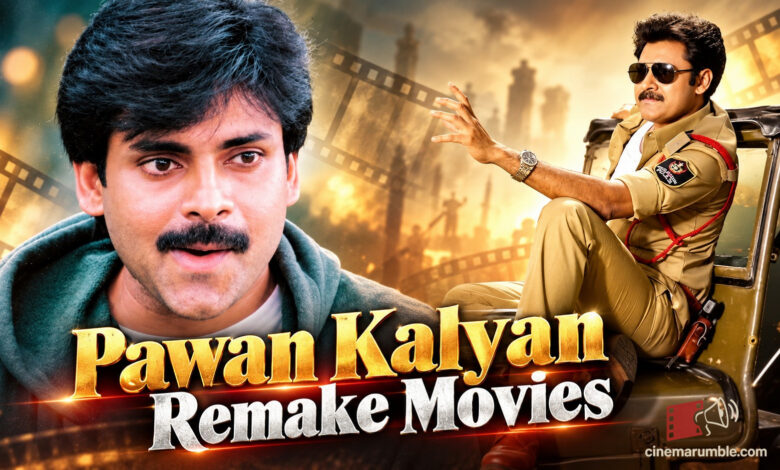
Pawan Kalyan’s remake movies reveal more than a list of borrowed plots. A doomed romance helped introduce him. Stories of stubborn young men shaped his early image. A Hindi policeman became Gabbar Singh, while later adaptations placed him inside courtroom drama, a clash of egos and a conversation with Time itself.
The important question is not just which film came first. It is what happened when the same story had to accommodate ‘Power Star’ Pawan Kalyan.
Sometimes that change produced a film with an identity of its own. Sometimes the star became larger than the material. Kushi and Gabbar Singh explain the possibilities; Teen Maar, Katamarayudu and Bro show why an attractive original cannot guarantee the same result in Telugu.
The choices below judge character writing, adaptation, and career significance. A preferred version is an editorial verdict, not a claim that its actor is universally better.
Pawan Kalyan remake movies: the originals at a glance
| Pawan Kalyan film | Earlier film and language | Corresponding original lead | Relationship |
|---|---|---|---|
| Akkada Ammayi Ikkada Abbayi (1996) | Qayamat Se Qayamat Tak (1988), Hindi | Aamir Khan | Direct remake |
| Gokulamlo Seeta (1997) | Gokulathil Seethai (1996), Tamil | Karthik | Direct remake |
| Suswagatham (1998) | Love Today (1997), Tamil | Vijay | Direct remake |
| Thammudu (1999) | Jo Jeeta Wohi Sikandar (1992), Hindi | Aamir Khan | Loose adaptation; separate from the confirmed-remake total |
| Kushi (2001) | Kushi (2000), Tamil | Vijay | Same-director version; initially planned as a bilingual project |
| Annavaram (2006) | Thirupaachi (2005), Tamil | Vijay | Localised remake |
| Teen Maar (2011) | Love Aaj Kal (2009), Hindi | Saif Ali Khan | Remake with structural changes |
| Gabbar Singh (2012) | Dabangg (2010), Hindi | Salman Khan | Official remake, extensively rewritten |
| Gopala Gopala (2015) | OMG – Oh My God! (2012), Hindi | Akshay Kumar’s divine character | Official remake; Venkatesh takes Paresh Rawal’s protagonist |
| Katamarayudu (2017) | Veeram (2014), Tamil | Ajith Kumar | Official remake |
| Vakeel Saab (2021) | Pink (2016), Hindi | Amitabh Bachchan | Official remake with an expanded lawyer’s story |
| Bheemla Nayak (2022) | Ayyappanum Koshiyum (2020), Malayalam | Biju Menon | Official remake with a stronger single-star emphasis |
| Bro (2023) | Vinodhaya Sitham (2021), Tamil | Samuthirakani’s Time character | Same-director remake; Sai Dharam Tej takes the mortal protagonist |
The early years: romance, rebellion, and a young star taking shape
1. Akkada Ammayi Ikkada Abbayi (1996): a famous love story, a different kind of debut
The Telugu film: Released on 11 October 1996, E. V. V. Satyanarayana’s film introduced Pawan Kalyan and Supriya Yarlagadda. Allu Aravind produced it under Geetha Arts; Koti composed the music, and S. Gopal Reddy handled cinematography. Nassar and Sarath Babu played the opposing fathers.
The original: Mansoor Khan’s Hindi film Qayamat Se Qayamat Tak arrived in 1988, with Aamir Khan as Raj and Juhi Chawla as Rashmi. Nasir Hussain’s writing and production, Anand–Milind’s songs, and a supporting cast including Dalip Tahil and Alok Nath helped establish a major romantic success.
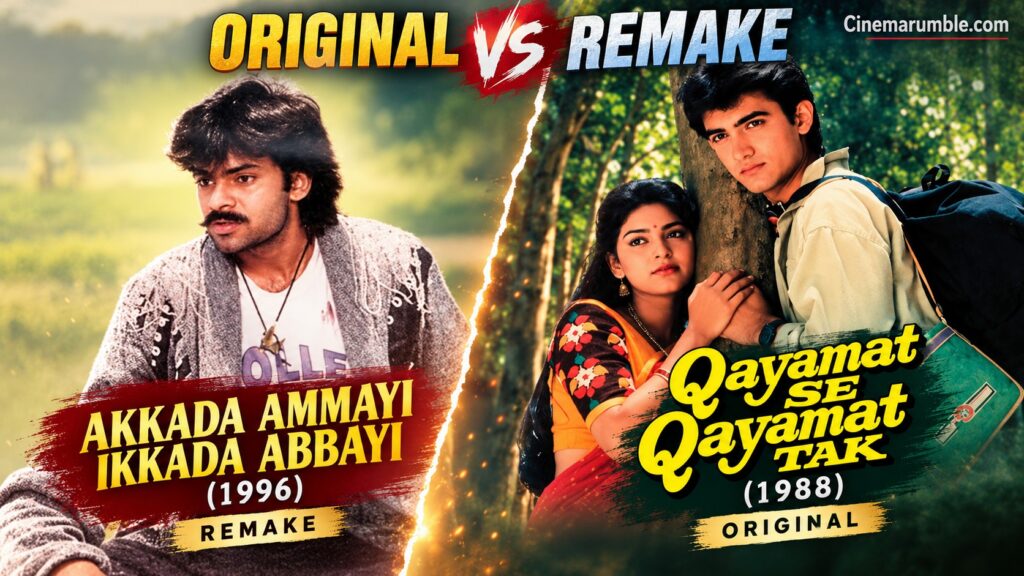
The connection is straightforward: young lovers become trapped inside a feud inherited from their families. Pawan’s Kalyan and Supriya’s character occupy the central romantic positions, while the Telugu film translates that hostility into its own village-and-family environment.
Yet the two films were not doing exactly the same job. Qayamat Se Qayamat Tak built its appeal around the vulnerability of its lovers. Akkada Ammayi Ikkada Abbayi also had to introduce an actor whose physical abilities were part of his attraction. Romance and the demonstration of a new hero therefore competed for attention.
Supriya should not disappear from this comparison. Both films depend on the woman choosing a relationship despite family pressure. Juhi’s Rashmi is central to the Hindi film’s lasting identity; the Telugu version is more often revisited as the beginning of Pawan’s career. That difference in legacy matters more than a scene-by-scene resemblance.
Reception and career effect: The Hindi original was a breakthrough commercial success. Pawan’s debut did not create a comparable romantic milestone, and dependable historical accounts do not justify attaching a precise lifetime collection here. His more distinctive screen identity would develop in subsequent films.
Our pick: Qayamat Se Qayamat Tak has the stronger claim as a defining romance. The remake’s particular interest is historical: it shows the young Pawan before his familiar mixture of defiance, humor and emotional awkwardness had fully formed.
2. Gokulamlo Seeta (1997): the heroine must be more than the hero’s reform program
The Telugu film: Muthyala Subbaiah directed this 22 August 1997 release, produced by B. Srinivasa Raju. Pawan Kalyan, Raasi and Harish led the cast, with Kota Srinivasa Rao in an important supporting role. Koti supplied the music, and Posani Krishna Murali wrote the dialogues.
The original: Agathiyan wrote and directed Gokulathil Seethai, released in Tamil in 1996. Karthik played Rishi, Suvalakshmi played Nila, and Karan played I. C. Mohan. Deva composed the music for the Lakshmi Movie Makers production.
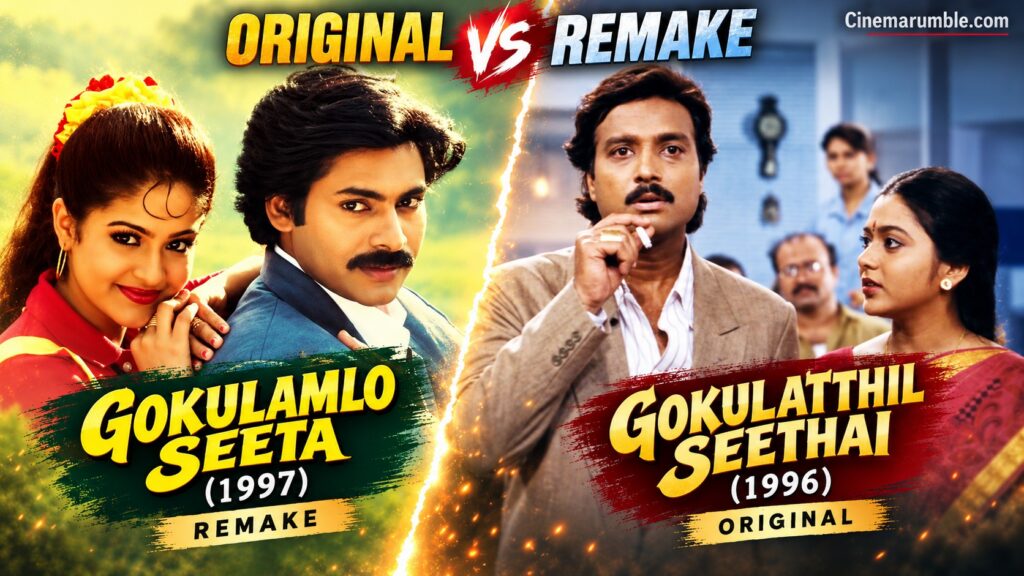
A wealthy, irresponsible young man’s attraction to a woman becomes a test of whether he can respect her as a person. In Telugu, Pawan’s Kalyan, Raasi’s Sirisha and Harish’s Bhaskar retain the central triangle, but the dramatic surroundings become those of a Telugu family melodrama.
The casting changes the starting point. Karthik brought an established romantic-hero identity to Rishi; Pawan was still defining what kind of leading man he would become. The remake consequently offered a useful early challenge: its hero could not simply be admirable from his first appearance.
The woman is the real test of either version. Nila and Sirisha are not prizes awarded for the man’s improvement. Their choices give the reform story its meaning. A comparison that discusses only Karthik and Pawan misses why the premise works at all. Karan and Harish also matter because the third participant prevents the conflict from becoming a private negotiation between a rich man and the woman he desires.
Reception and reach: Both films found commercial acceptance. The original’s appeal traveled into three other languages: Telugu, Kannada through Krishna Leele (2000), and Hindi through Hum Ho Gaye Aapke (2001), which Agathiyan also directed.
Our pick: The Tamil film is the more useful starting point for understanding this character-driven premise. The Telugu version’s importance is different: it broadened Pawan’s early acting assignments and demonstrated that his career need not depend only on an introductory action image.
3. Suswagatham (1998): the Thalapathy Vijay connection before Kushi
The Telugu film: Released on 1 January 1998, Suswagatham was directed by Bhimaneni Srinivasa Rao and produced by R. B. Choudary. Pawan played Ganesh opposite Devayani’s Sandhya. Raghuvaran, Prakash Raj and Karan were key supporting actors; S. A. Rajkumar composed the music.
The original: This is Balasekaran’s Love Today from 1997, not the unrelated 2022 film. Vijay and Suvalakshmi played Ganesh and Sandhya, with Raghuvaran, Rajan P. Dev and Karan in the supporting cast. R. B. Choudary produced the Tamil film too, while Shiva composed its soundtrack.
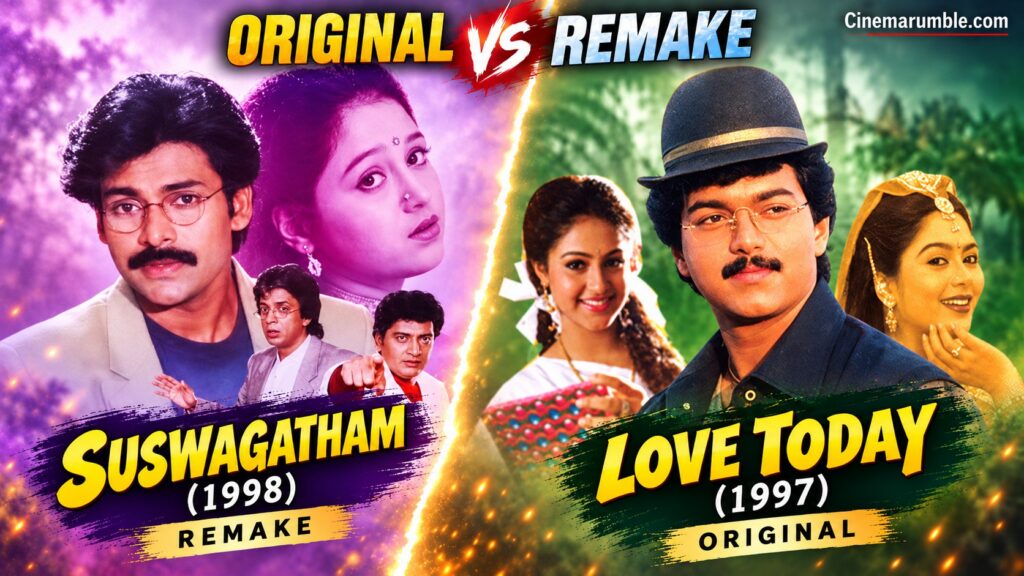
The premise is deliberately uncomfortable: a young man invests almost everything in a woman who does not share his certainty about the relationship. The consequences extend beyond the lovers, particularly into his relationship with his father.
Raghuvaran is the vital bridge between the films. Keeping him as the father preserves a connection that a hero-versus-hero comparison would otherwise overlook. Vijay and Pawan inhabit the same broad youthful obsession, but the father-son relationship supplies the emotional cost of that obsession.
Devayani and Suvalakshmi also deserve a fair reading. Sandhya’s hesitation is not a performance problem to be solved by making her more affectionate. It belongs to the story. Prakash Raj takes the stern paternal position occupied by Rajan P. Dev, giving the Telugu version another substantial presence around its young leads.
Reception and career effect: Love Today was a successful Tamil release, and Suswagatham continued Pawan’s early commercial progress. Its emotionally demanding material strengthened a side of his image that cannot be explained through action alone. The story also traveled into Kannada as Majnu and Hindi as Kya Yehi Pyaar Hai (2002).
Our pick: Both versions make a strong emotional case. Suswagatham has a strong claim as Pawan’s early emotional calling card; Love Today remains essential for the original framing. Raghuvaran’s shared role is the best reason to watch the pair rather than treat one as disposable.
4. Thammudu (1999): the loose adaptation that became unmistakably Pawan’s
The Telugu film: P. A. Arun Prasad directed Thammudu, released on 15 July 1999. Pawan played Subrahmanyam, usually called Subbu, with Preeti Jhangiani, Aditi Gowitrikar, Achyuth and Bhupinder Singh. Ramana Gogula composed the music, Madhu Ambat was the cinematographer, and B. Sivarama Krishna produced it.
The earlier film: Mansoor Khan’s Jo Jeeta Wohi Sikandar (1992) starred Aamir Khan as Sanjay, Ayesha Jhulka as Anjali, Pooja Bedi as Devika, Mamik as Ratan and Deepak Tijori as Shekhar. Jatin-Lalit composed its music.
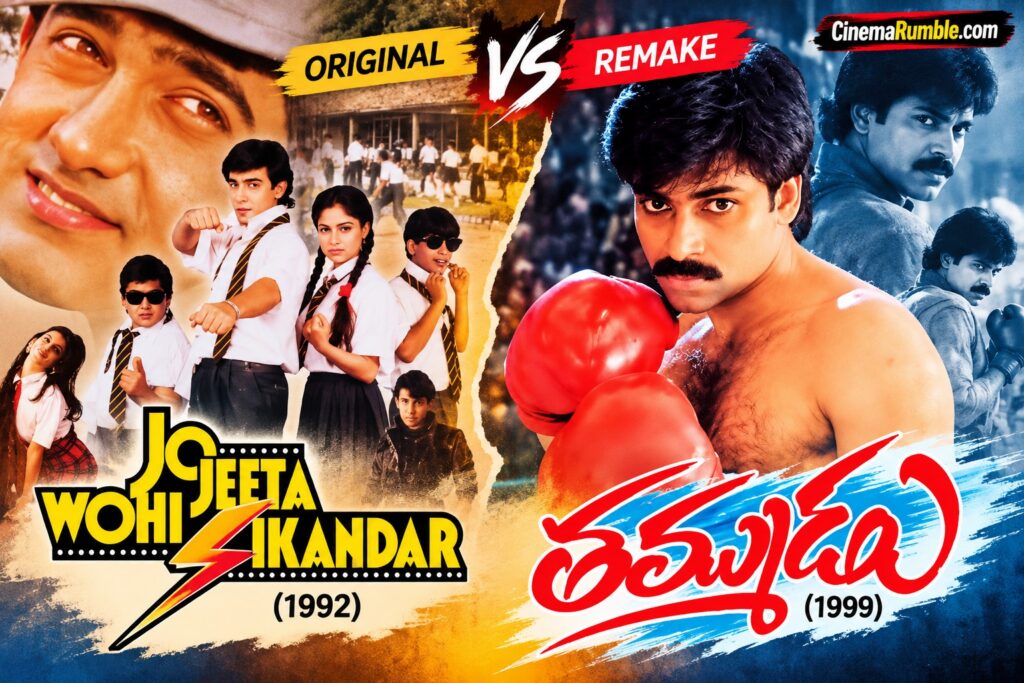
The shared skeleton is clear: an irresponsible younger brother, a more disciplined elder sibling, romantic confusion and a sporting contest that demands maturity. The crucial change is the sport. Cycling gives way to kickboxing, bringing Pawan’s physical screen identity into the center of the adaptation.
That is more than replacing bicycles with punches. The original connects sport to educational institutions, class rivalry and a young man’s shame about his background. Thammudu reorganizes the material around family pride and a fighter’s transformation. Achyuth’s elder brother is therefore not incidental; his position gives Subbu’s change a personal obligation.
Preeti Jhangiani’s loyal Janaki corresponds broadly to Ayesha Jhulka’s Anjali, while Aditi Gowitrikar occupies the glamorous attraction represented by Pooja Bedi. These are functional parallels, not permission to declare every moment identical. Pawan’s route to maturity is built around a different athletic image from Aamir’s.
Classification and reception: Treat this as a loose adaptation or inspiration-based reworking, not a rights-verified official remake. It became a major success for Pawan and subsequently traveled into Tamil as Vijay’s Badri (2001) and Kannada as Yuvaraja (2001).
Music and our pick: Ramana Gogula’s soundtrack gives Thammudu a separate musical identity; Jatin-Lalit’s Pehla Nasha belongs to the Hindi original’s romantic memory. Jo Jeeta Wohi Sikandar has the edge for the broader coming-of-age setting. Thammudu is the more revealing film about how a borrowed framework can be rebuilt around Pawan’s specific strengths.
5. Kushi (2001): a remake relationship that needs an asterisk
The Telugu film: S. J. Suryah directed Pawan Kalyan and Bhumika Chawla in the film released on 27 April 2001. A. M. Rathnam produced it; Mani Sharma composed the music, and P. C. Sreeram handled cinematography. Vijayakumar and Ali were among the important supporting performers.
The earlier version: Suryah’s Tamil Kushi was released in 2000 with Vijay and Jyothika, backed by the same producer. Deva composed its soundtrack. The project was initially conceived for both languages, but the Tamil version reached audiences first.
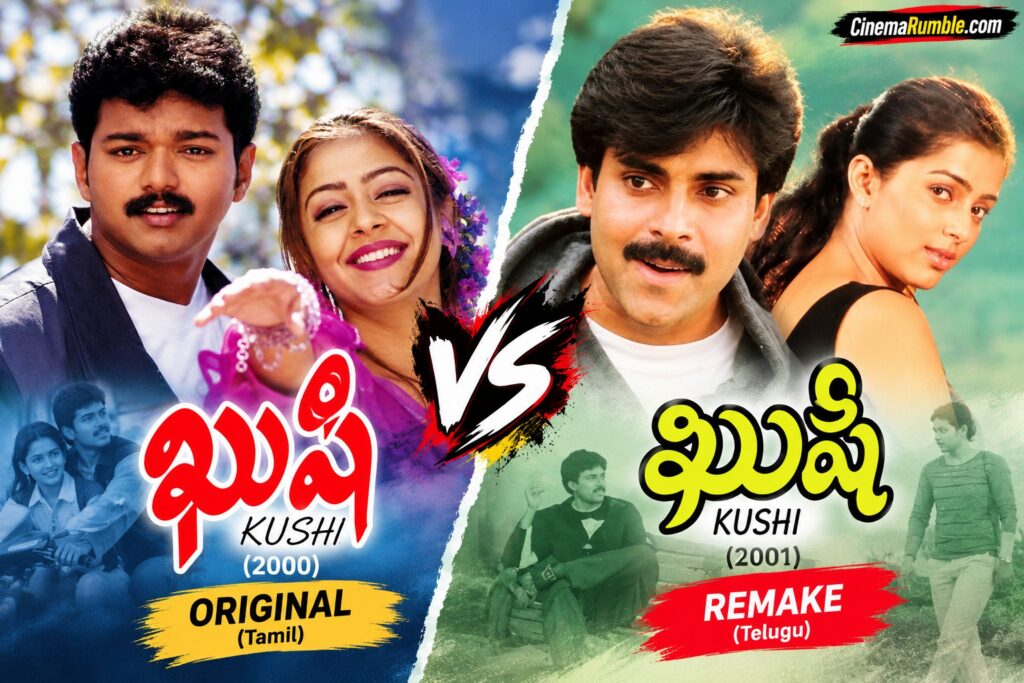
So, is Pawan Kalyan’s Kushi a remake? In release order and its shared story, the connection is clear. Calling it merely a later copy, however, loses the common production origins and the same filmmaker’s involvement.
The conflict is not principally a villain keeping lovers apart. It is the lovers themselves. Pawan’s Siddhu and Bhumika’s Madhu, like Vijay’s Shiva and Jyothika’s Jenny, are repeatedly defeated by pride, assumptions, and an inability to handle attraction honestly.
That makes the women indispensable. Remove Madhu’s resistance and Siddhu no longer has an equal dramatic opponent. Remove Jenny’s stubbornness and the Tamil film loses the same engine. Bhumika and Jyothika should be compared as the other half of the argument, not as ornaments beside two popular heroes.
The soundtracks also stop the versions from feeling interchangeable. Deva’s Tamil songs and Mani Sharma’s Telugu album establish different musical memories. Ammaye Sannaga, Cheliya Cheliya and Ye Mera Jaha are useful starting points for revisiting the Telugu album and its connection to Pawan’s early screen image.
Reception and career effect: Both versions succeeded, and Telugu Kushi became a career-defining blockbuster. Its later theatrical return demonstrated continuing interest, but re-release business should not be confused with what the film earned in 2001. The story also reached Hindi as Khushi (2003), with Fardeen Khan and Kareena Kapoor, and Kannada as Eno Onthara (2010), with Ganesh and Priyamani.
Our pick: For this Pawan career study, Telugu Kushi gets the edge because the material became so closely associated with his youthful screen personality. The Tamil film remains an equally necessary part of the story, especially for the Vijay-Jyothika pairing. This is a case of two identities, not one authentic film and one expendable imitation.
From familiar stories to mass-star vehicles
6. Annavaram (2006): sister sentiment becomes the reason for a city clean-up
The Telugu film: Bhimaneni Srinivasa Rao returned to direct Pawan in Annavaram, released on 29 December 2006. Sandhya played his sister and Asin the romantic lead, with Siva Balaji, Venu Madhav, Lal and Ashish Vidyarthi in key roles. N. V. Prasad and Paras Jain produced it. Ramana Gogula composed the songs, and Dhina supplied the background score.
The original: Perarasu wrote and directed Thirupaachi (2005), starring Vijay, Trisha and Mallika. Its soundtrack involved Dhina, Devi Sri Prasad and Mani Sharma. Pasupathy, Kota Srinivasa Rao, and other antagonists gave the city-crime storyline several opposing figures.
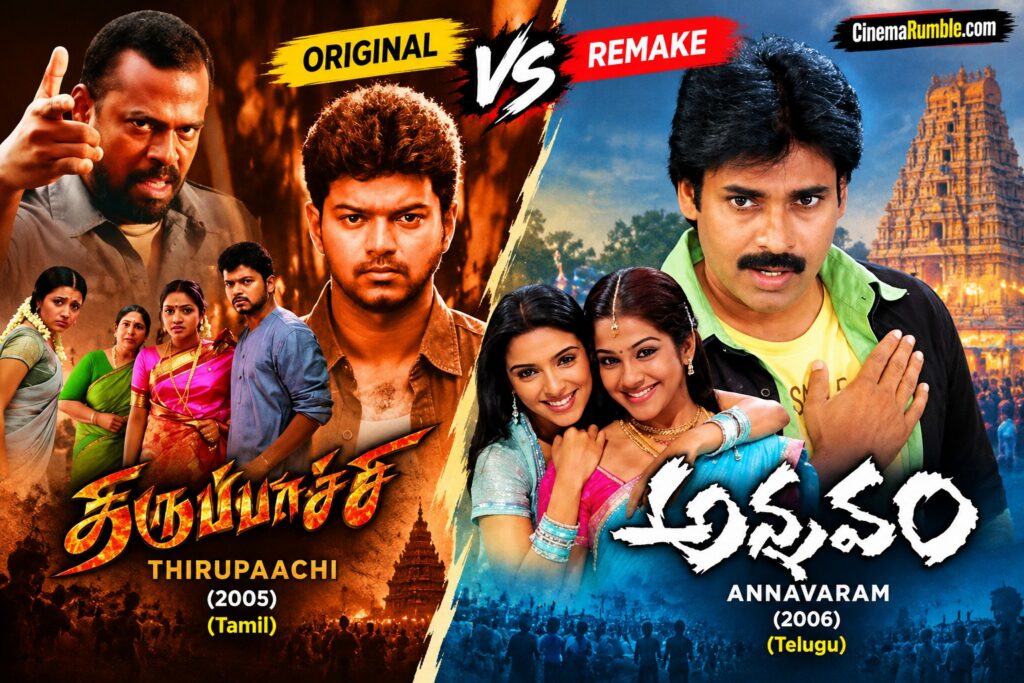
A protective village brother wants his sister to have a secure married life in the city. When that city proves dangerous, his family responsibility expands into a mission against its criminal network. Chennai becomes Hyderabad, but the narrative bridge between sister sentiment and public violence remains.
The crucial female comparison is therefore Sandhya against Mallika, not only Asin against Trisha. The sister is the reason the hero enters the conflict. The romantic heroine has less control over the story in either version, which limits what a fair performance comparison can demand from her.
Vijay’s Sivagiri and Pawan’s Annavaram occupy the same protective-brother position. Venu Madhav’s friendship material and the Telugu supporting ensemble help localize the surroundings, while the villains must justify a threat big enough to turn a private family concern into sustained action.
Reception and reach: Thirupaachi was a commercial success and also became the Kannada film Thangigagi (2006). Annavaram received mixed reviews, while later trade descriptions vary around an average or modest result rather than an uncontested blockbuster. It kept Pawan within the family-action space without becoming a Kushi-sized turning point.
Our pick: Thirupaachi has the stronger claim as the defining version of this particular brother-to-vigilante formula. Annavaram’s best argument is its Telugu family context, not the idea that adding Pawan automatically improves the entire design.
7. Teen Maar (2011): why the narrator matters as much as the two romances
The Telugu film: Jayanth C. Paranjee directed Teen Maar, released on 14 April 2011. Pawan played Michael Velayudham and Arjun Palwai, with Trisha, Kriti Kharbanda, Paresh Rawal and Sonu Sood. Bandla Ganesh produced it, Trivikram supplied the adapted screenplay and dialogues, and Mani Sharma composed the music.
The original: Imtiaz Ali’s Love Aaj Kal (2009) starred Saif Ali Khan as contemporary lover Jai and the younger Veer. Deepika Padukone played Meera, Giselli Monteiro played Harleen, and Rishi Kapoor played the older Veer. Pritam composed the soundtrack.
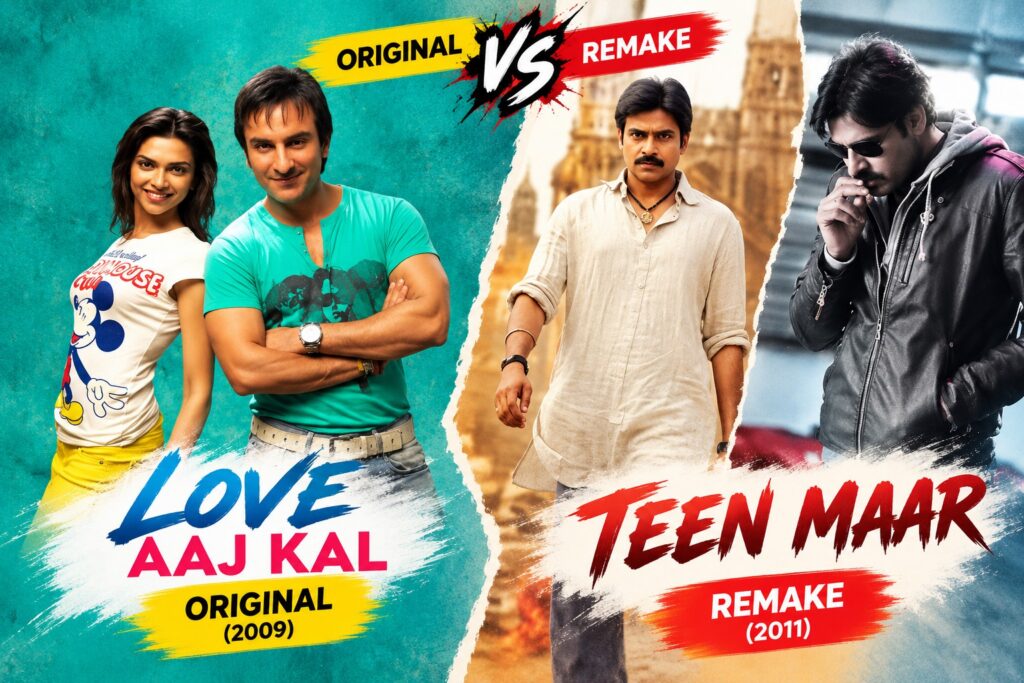
Two love stories ask whether modern convenience has changed love itself or merely the way people explain it. Michael and Meera occupy the contemporary track; Arjun and Vasumathi carry the older romance. Cape Town and the Varanasi-set past give the Telugu film its own geographical pattern.
The most meaningful alteration is not a location. In Love Aaj Kal, Rishi Kapoor’s older man narrates his own history. In Teen Maar, Paresh Rawal’s character recounts another man’s story. The original narrator’s personal stake becomes a more detached account, changing how the two generations connect.
Pawan’s dual casting asks him to embody contrasting attitudes rather than one continuously heroic personality. Trisha and Deepika are crucial to the modern relationship’s negotiation of work, distance, and commitment. Kriti and Giselli belong to the contrasting period romance. Sonu Sood’s alternative-suitor role adds another presence to the Telugu emotional equation.
Reception and career effect: Love Aaj Kal was commercially successful, with reported lifetime India nett of approximately ₹66 crore. Teen Maar underperformed. Its failure did not prove that Pawan could not do romance; it showed that a successful romantic structure and a major star were not sufficient by themselves to reproduce the original’s commercial appeal.
Our pick: Love Aaj Kal has the stronger narrative connection between past and present, particularly through the older Veer. Teen Maar is worth considering for the unusual contrast between Pawan’s two characters, but the original’s narrator gives it the edge.
8. Gabbar Singh (2012): the remake that understood when to stop being faithful
The Telugu film: Released on 11 May 2012, Gabbar Singh was directed by Harish Shankar and produced by Bandla Ganesh. Pawan’s Venkataratnam Naidu adopts the Gabbar Singh identity. Shruti Haasan plays Bhagyalakshmi, Abhimanyu Singh plays Siddhappa Naidu, and Suhasini, Nagineedu, Ajay and Ali support the central story. Devi Sri Prasad composed the music.
The original: Abhinav Kashyap’s Dabangg (2010) starred Salman Khan as Chulbul Pandey, Sonakshi Sinha as Rajjo, Sonu Sood as Cheddi Singh, and Arbaaz Khan as Makkhi. Sajid-Wajid composed the main soundtrack, with Lalit Pandit’s Munni Badnaam Hui also part of its musical identity.
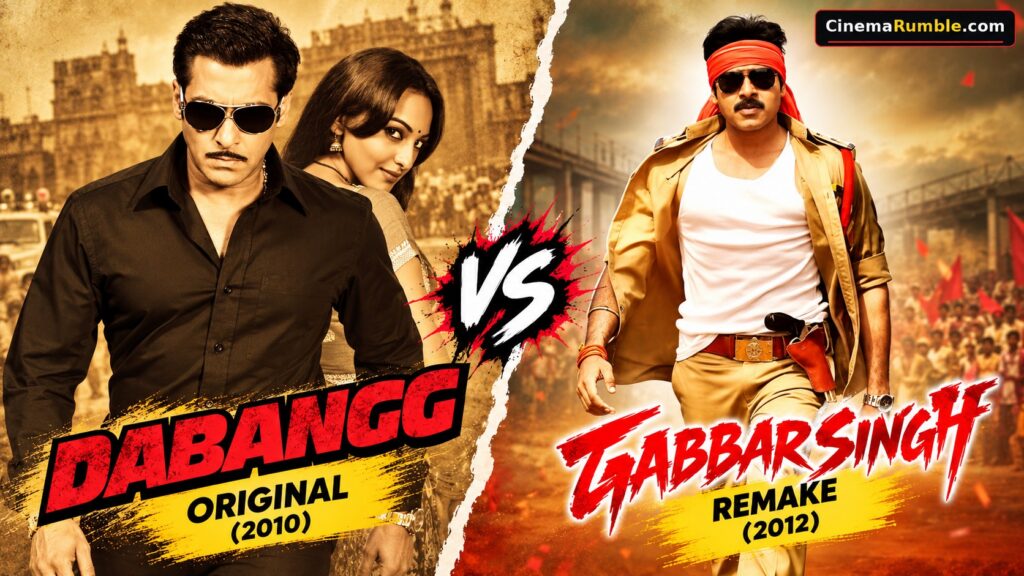
Both films begin with a policeman who refuses to behave like an obedient representative of the institution. Family resentment, romance, and political-criminal opposition surround him. But Harish Shankar did not treat the Hindi screenplay as an untouchable instruction manual.
The Telugu dialogue, revised second half, and police-station antakshari sequence are significant examples of rebuilding. They allow humor and the star’s irreverent image to shape the experience rather than simply inserting Telugu names into Chulbul Pandey’s world.
Salman’s Chulbul and Pawan’s Gabbar consequently belong to related but different performance designs. The original makes its policeman’s eccentricity part of a rough family-and-crime environment. The remake gives Pawan’s refusal to conform a more overtly playful platform. This is an adaptation choice, not evidence that one actor could replace the other without changing the film.
Shruti’s Bhagyalakshmi and Sonakshi’s Rajjo remain the romantic counterparts, but neither controls the main action. Abhimanyu Singh’s political antagonist takes over the threat represented by Sonu Sood, while Ali and the police-station ensemble help create a specifically Telugu comic environment.
Reception and career effect: Both films were major commercial successes. Gabbar Singh became a blockbuster and an important return to commercial form for Pawan. It is still inaccurate to describe this as his first success since Kushi, as it erases Jalsa from the intervening years. Dabangg also became Tamil’s Osthe (2011) starring STR (Silambarasan aka Simbu).
Our pick: Gabbar Singh is the strongest example here of successful star-specific localization. Dabangg deserves credit for the character and framework; the Telugu version earns its place by discovering another personality inside them. Pillaa, from Devi Sri Prasad’s album, complements that separate identity.
9. Gopala Gopala (2015): Pawan plays God, but Venkatesh owns the human problem
The Telugu film: Kishore Kumar Pardasany, known as Dolly, directed this 10 January 2015 release. D. Suresh Babu and Sharrath Marar produced it. Venkatesh, Pawan Kalyan, Shriya Saran and Mithun Chakraborty led the cast, with music by Anoop Rubens.
The original: Umesh Shukla directed OMG – Oh My God! (2012), starring Paresh Rawal, Akshay Kumar, Lubna Salim and Mithun Chakraborty. It was adapted from the Gujarati play Kanji Viruddh Kanji, making this a stage-to-Hindi-to-Telugu adaptation.
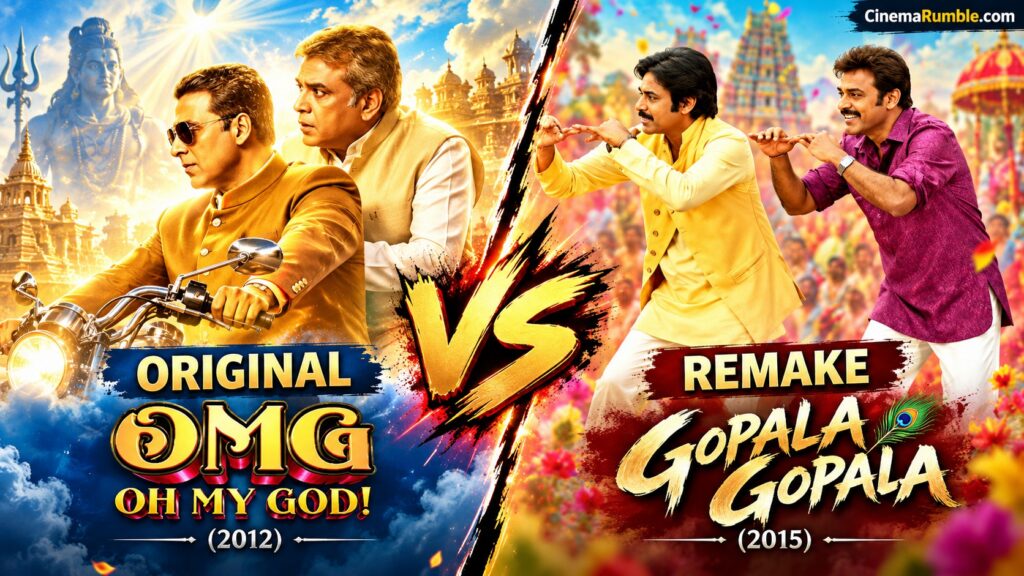
The mapping is important. Pawan takes Akshay Kumar’s divine role. Venkatesh takes Paresh Rawal’s shopkeeper protagonist. Shriya is the wife of Venkatesh’s Gopala Rao, not a romantic partner assigned to Pawan.
A trader’s dispute over an insurance exclusion opens a wider challenge to religious profiteering. The drama depends on an ordinary man being willing to question powerful institutions. God enters that argument, but the mortal character must continue to carry its consequences.
Paresh Rawal’s Kanji and Venkatesh’s Gopala Rao are therefore the first performances that should be placed beside each other. Pawan and Akshay provide different star presences around the same supernatural function. Shriya and Lubna give the argument a family setting, while Mithun’s return in the religious-establishment space supplies another bridge between versions.
Anoop Rubens’s Bhaje Bhaaje makes the Telugu film’s devotional register explicit. It also illustrates the balancing act: a story can challenge the business conducted in God’s name while still making room for belief. That is more precise than describing either film simply as anti-religion.
Reception and reach: OMG was a commercial success. Gopala Gopala’s financial reception was more mixed across territories than a blanket blockbuster label suggests. It offered Pawan a different, relatively contained star role within a Venkatesh-led story. The Hindi source also became Kannada’s Mukunda Murari (2016).
Our pick: OMG has the stronger claim when the priority is the shopkeeper’s argument. Gopala Gopala’s distinguishing attraction is the Venkatesh–Pawan combination. Its success as an adaptation should be judged by whether that pairing supports the argument, not merely by the pleasure of seeing Pawan as Krishna.
10. Katamarayudu (2017): Veeram’s family formula meets Rayalaseema styling
The Telugu film: Released on 24 March 2017, Katamarayudu reunited Pawan with Dolly and producer Sharrath Marar. Shruti Haasan played Avanthika; Ali, Ajay, Siva Balaji, Kamal Kamaraju, Chaitanya Krishna and Nassar filled important supporting positions. Anoop Rubens composed the music and Prasad Murella handled cinematography.
The original: Siva directed Veeram (2014), with Ajith Kumar (THALA Ajith) as Vinayagam and Tamannaah as Kopperundevi. Santhanam, Nassar, and the brothers’ ensemble supported them. Devi Sri Prasad composed the music.
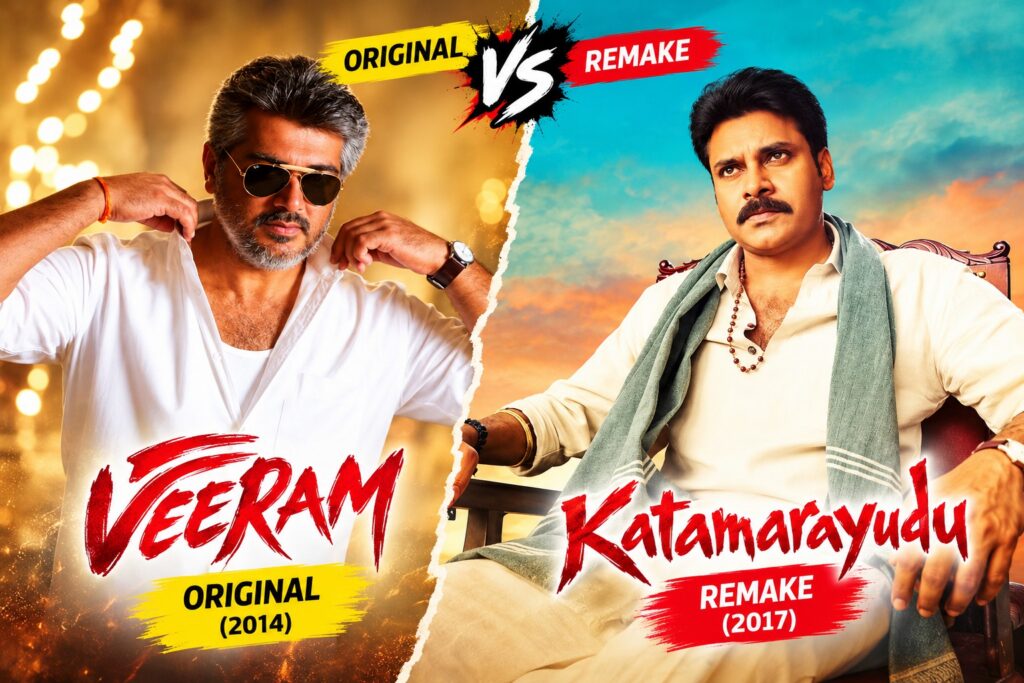
The oldest of a group of brothers avoids marriage. His younger siblings, whose own romantic plans are stuck behind that decision, help bring a woman into his life. Her family’s dislike of violence then collides with the hero’s existing way of solving problems.
Katamarayudu retains this engine while moving into a Rayalaseema-coded world of family authority, factional conflict and rural masculinity. Pawan isn’t simply wearing Ajith’s costume; the geographical and social associations around the eldest brother shift.
However, the underlying character balance remains a challenge. Shruti and Tamannaah must represent the possibility of a different life, yet the action framework repeatedly pulls attention back towards the man. Ali takes the main comic space Santhanam occupied, while the brothers need to function as a family rather than a collection of hero-supporting reactions.
Reception and reach: Veeram was a successful Tamil star vehicle. Katamarayudu opened with considerable star-driven business but underperformed over its full run. Published final-share estimates differ, so an exact collection is less useful than that broad outcome. The Veeram story later also reached Kannada through Odeya (2019) and Hindi through the heavily reworked Kisi Ka Bhai Kisi Ki Jaan (2023).
Our pick: Veeram is the clearer starting point for the brothers-and-bachelorhood formula. Katamarayudu changes the regional flavor more convincingly than it changes the dramatic design. For Pawan’s career, this was a reminder that familiarity with a successful template is not the same as fresh material.
The later phase: the star steps into somebody else’s argument
11. Vakeel Saab (2021): Pink’s women and a lawyer who becomes the headline
The Telugu film: Venu Sriram directed Vakeel Saab, released on 9 April 2021. Pawan played Satyadev, supported by Nivetha Thomas, Anjali, Ananya Nagalla, and Prakash Raj, with Shruti Haasan in the lawyer’s expanded personal story. Thaman composed the music; P. S. Vinod handled cinematography.
The original: Aniruddha Roy Chowdhury directed Pink (2016), written by Ritesh Shah. Amitabh Bachchan played Deepak Sehgal, while Taapsee Pannu, Kirti Kulhari, and Andrea Tariang played the three women. Piyush Mishra was the opposing lawyer. Ajith’s Nerkonda Paarvai (2019), directed by H. Vinoth, is another major branch of the same remake family.
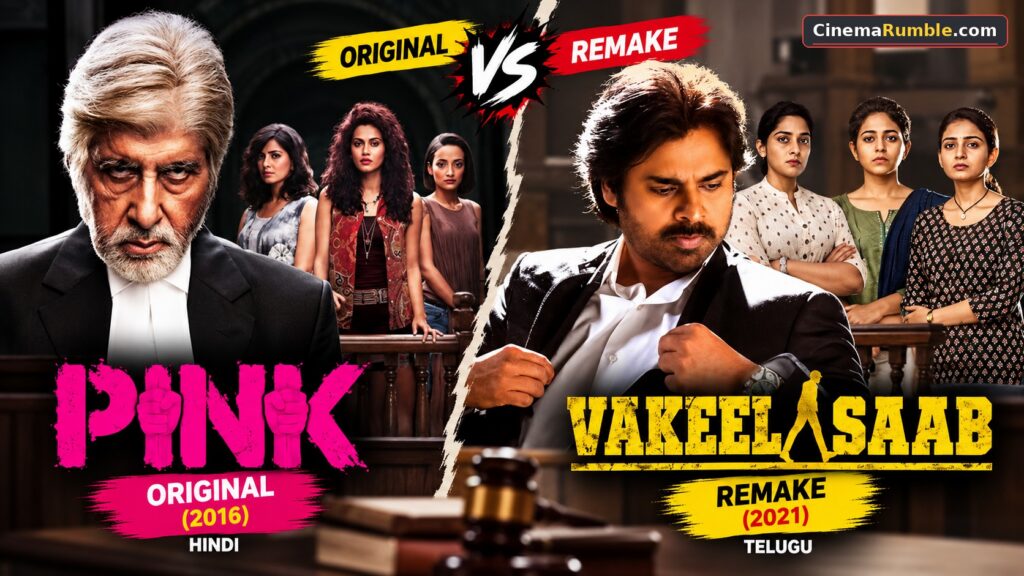
The central issue is consent and the attempt to discredit women through assumptions about their behavior. The casting map should keep those women visible: Nivetha’s Pallavi corresponds to Taapsee’s Minal; Anjali’s Zareena to Kirti’s Falak; Ananya’s Divya to Andrea’s character.
The largest adaptation decision is the expanded importance of the lawyer. Satyadev receives a fuller heroic and personal framework, including action and a romantic backstory. Pawan is consequently being asked to carry a star vehicle alongside the courtroom argument, rather than only occupy the professional position Bachchan held.
There are meaningful changes in the women’s circumstances too. The Telugu film makes their initial encounter more dependent on a breakdown and the need for assistance. That matters because an argument about consent should not require women to be exceptionally cautious or conventionally respectable before they deserve protection.
Prakash Raj and Piyush Mishra provide the adversarial courtroom roles. Shruti’s material must be judged as part of the added lawyer-centered design, not confused with the experiences of the three women at the heart of the case.
Reception and career effect: Pink combined substantial critical recognition with commercial success; Vakeel Saab marked Pawan’s return to theatrical releases after a gap, but its 2021 run faced pandemic disruption, and strong opening business did not translate into an undisputed all-territory profit verdict.
Our pick: Pink has the stronger case for keeping the women’s experience central. Vakeel Saab offers a larger platform for Pawan’s screen authority, but that expansion comes with a narrative cost. The better adaptation is not necessarily the one that gives its biggest star the most material.
12. Bheemla Nayak (2022): when two names become one title
The Telugu film: Saagar K. Chandra directed Bheemla Nayak, released on 25 February 2022. Trivikram adapted the screenplay and dialogues; S. Naga Vamsi produced it. Pawan, Rana Daggubati, Nithya Menen and Samyuktha led the cast. Thaman composed the music and Ravi K. Chandran handled cinematography.
The original: Sachy wrote and directed Ayyappanum Koshiyum (2020), starring Biju Menon and Prithviraj Sukumaran. Gowri Nandha, Anna Rajan, Ranjith, and Anil Nedumangad were important to its world. Jakes Bejoy composed the music, and Sudeep Elamon was the cinematographer.
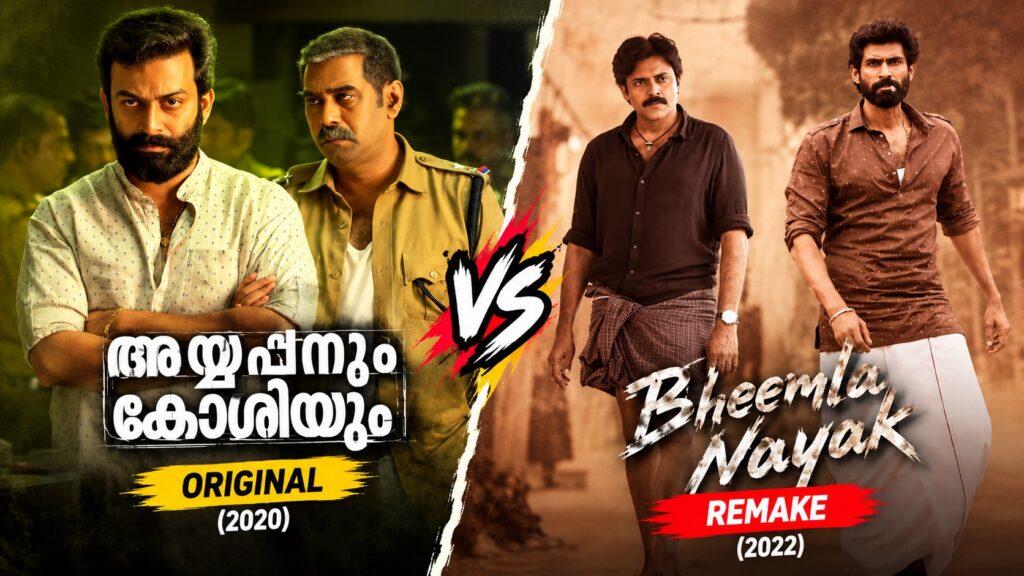
The correct male pairing is Pawan’s Bheemla Nayak with Biju Menon’s Ayyappan Nair, and Rana’s Daniel Shekhar with Prithviraj’s Koshy Kurien. Getting that wrong turns the entire comparison upside down.
An encounter between a policeman and a well-connected outsider develops into an escalating contest of pride. The Malayalam film builds that conflict around Attappady, authority, class, and the consequences of refusing to retreat. The Telugu version relocates the environment and gives its policeman a more pronounced star-centered heroic presentation.
Even the titles reveal the decision: Ayyappanum Koshiyum names both participants; Bheemla Nayak names one. That does not make Rana unimportant. On the contrary, Daniel must retain enough resistance for Bheemla’s struggle to remain a conflict rather than a procession of victories.
The women are not interchangeable background figures. Nithya’s Suguna corresponds to Gowri Nandha’s Kannamma, while Samyuktha’s Kamali occupies the family position represented by Anna Rajan’s Ruby. Their relationships with the men reveal the domestic cost of public pride. Samuthirakani and Ranjith, as the outsiders’ fathers, also help explain the entitlement feeding the confrontation.
Reception and career effect: The Malayalam original was a commercial success with a substantial critical reputation. Bheemla Nayak opened strongly, but final trade assessments recorded uneven territorial recovery, including an average overall verdict rather than a clean blockbuster result. Creatively, it gave Pawan a forceful adversarial pairing with Rana and another role built around institutional authority.
Our pick: Ayyappanum Koshiyum has the stronger design as a two-man character conflict. Bheemla Nayak is the choice for a more overt Pawan-led action treatment. The difference is not subtle, and recognizing it is more useful than declaring one actor superior to another.
13. Bro (2023): Time becomes a star, and the ordinary man becomes younger
The Telugu film: Samuthirakani directed Bro, released on 28 July 2023, with Trivikram adapting its screenplay and dialogues. Pawan played Time, also called Titan, alongside Sai Dharam Tej’s Markandeyulu. Ketika Sharma, Rohini, and Priya Prakash Varrier were important supporting performers. Thaman composed the music for the People Media Factory and Zee Studios production.
The original: Samuthirakani’s Tamil Vinodhaya Sitham premiered on ZEE5 on 13 October 2021. Thambi Ramaiah played Parasuram, Samuthirakani played Time, and Sriranjini was among the principal supporting actors. C. Sathya composed the music. The film’s earlier source was Sreevathson’s stage play of the same name.
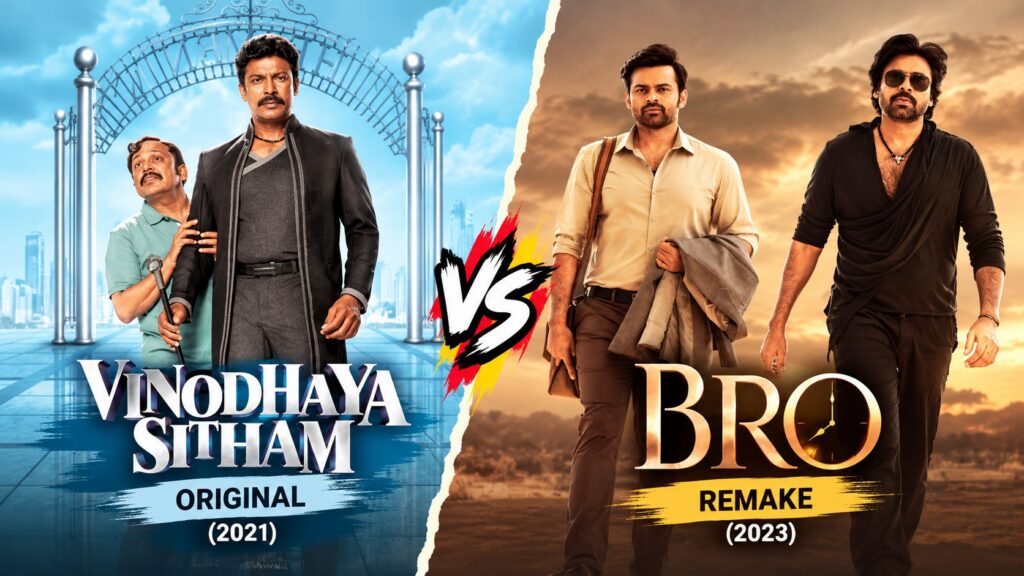
Here again, Pawan does not take the ordinary protagonist’s role. Sai Dharam Tej takes the position occupied by Thambi Ramaiah; Pawan takes Samuthirakani’s supernatural role.
A man who believes his family and workplace cannot function without him receives a limited extension after a fatal accident. The fantasy allows him to examine the difference between responsibility and control without revealing the ending in advance.
The shift from an older family patriarch to a younger corporate breadwinner changes the story’s emphasis. Parasuram’s experience challenges a man’s long-established control over others. Mark’s story also has to accommodate youthful ambition, romance, and the weight he places on himself as the family’s provider.
The Tamil film should not assign Ketika’s girlfriend and Rohini’s mother artificial one-to-one equivalents. Sriranjini’s wife belongs to a different household structure. These changes are the remake’s substance, not minor casting trivia.
The other major expansion is Pawan himself: the film makes room for his star image and callbacks. That offers a different attraction from the smaller original, but it also competes with the mortal character’s self-examination.
Reception and career effect: Vinodhaya Sitham was a direct-to-streaming release, so giving it a theatrical collection or a theatrical blockbuster label would be misleading. It received favorable critical attention. Bro underperformed theatrically. Its casting was distinctive, but a successful small-scale digital premise did not automatically become an equally successful large-star release.
Our pick: Vinodhaya Sitham is the more focused choice for the central idea about control and mortality. Bro is primarily the alternative for viewers interested in the Pawan–Sai Dharam Tej pairing. The longer chain is important: stage play → Tamil film → Telugu star adaptation.
View Vinodhaya Sitham on its official ZEE5 page. Playback, language options, and subscription requirements can vary by region.
Is Ustaad Bhagat Singh a remake of Theri?
Older announcements and reports linked the project to Theri. However, Harish Shankar subsequently said that the remake plan had been dropped and that Ustaad Bhagat Singh was not a remake. His clarification around the film’s March 2026 release takes precedence over the earlier description.
It is therefore excluded from the confirmed-remake count here. Shared police-film elements are not enough to override that distinction. An outdated project description shouldn’t become an evergreen fact just because it appears on several lists.
What these films reveal about Pawan Kalyan’s career
The source-language pattern is revealing: six Tamil films, five Hindi films and one Malayalam film account for the 12 established remakes. The balance changes as the career develops, but the useful distinction is what each phase asks the star to do.
In the early films, Pawan is often the person who must change. He has to learn respect, reconsider obsession, accept responsibility, or overcome ego. The women and families around him are not simply waiting to applaud. They create the resistance that makes his character interesting.
Gabbar Singh shifts the balance. Its pleasure lies partly in a hero refusing to become more obedient. Harish Shankar’s localization works because the star’s personality becomes a creative resource rather than an addition pasted over the original. It is one reason the film can stand beside Dabangg without depending on the argument that the source was inadequate.
Later adaptations raise a different question: can an established star enter a story without pulling it away from its original center? Vakeel Saab expands the lawyer around a women-focused case. Bheemla Nayak gives one name greater prominence within a two-man conflict. Bro turns a restrained supernatural function into a conspicuous star attraction.
Those changes are not automatically wrong. They must earn their place. A remake succeeds creatively when the new emphasis creates something worth having, not just something bigger.
Kushi, Thammudu and Gabbar Singh are the clearest career arguments for transformation. They show material becoming associated with Pawan in ways that go beyond translation. Teen Maar and Katamarayudu demonstrate that a respected or successful original cannot supply an actor’s next hit on demand. Bro shows the additional difficulty of enlarging a small, idea-led film without losing its center.