🎬 Jailer 2 Movie Review – Big Laughs, Bigger Rajini Moments and a Huge Blockbuster!

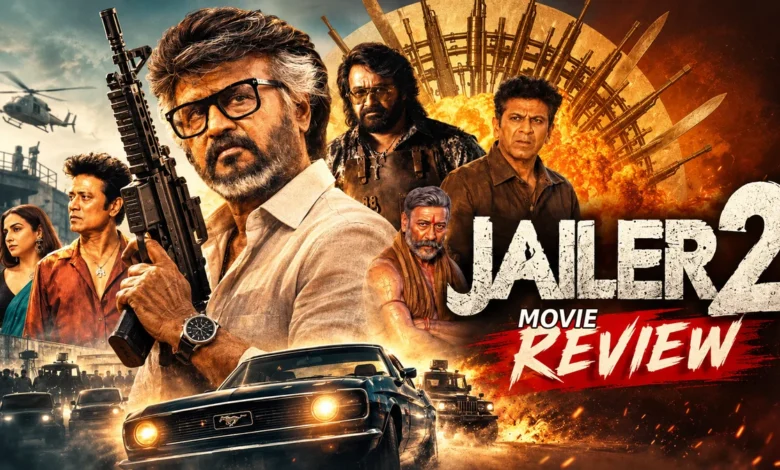
Rajinikanth and Nelson Dilipkumar are most entertaining here when a dangerous man is caught up in seemingly ordinary comic situations. Their sequel to Jailer expands Tiger Muthuvel Pandian’s world, but bigger isn’t always better.
This Jailer 2 review asks whether the added scale strengthens the storytelling or simply creates more room for star celebration. Nelson finds a particularly enjoyable answer before the interval.
🎞️ Movie Details
Movie: Jailer 2
Language: Tamil
Genre: Action comedy
Cast: Rajinikanth, Ramya Krishnan, Mirnaa, Namo Narayana, Yogi Babu, Suraj Venjaramoodu, S. J. Suryah, Vidya Balan and Mithun Chakraborty; Cameo – Mohanlal, Shiva Rajkumar, Hrithik Roshan, Jackie Shroff
Writer and director: Nelson Dilipkumar
Music: Anirudh Ravichander
Cinematography: Kartik Kannan
Editing: R. Nirmal
Producer: Kalanithi Maran
Production: Sun Pictures
Release date: 15 October 2026
✍️ Story
Some time after the earlier film, Tiger Muthuvel Pandian is living quietly with his wife and family near Coimbatore. He works as a supermarket supervisor, keeping his formidable past away from his everyday routine. That peace cannot last while unfinished business from Varman’s idol-smuggling operation remains.
Dileep seeks answers about Varman and the missing containers of stolen idols. Beyond him sits the Goa-based Kalpak family, which controls a much larger criminal network. As these interests converge, Tiger’s apparently modest life becomes entangled with people who have considerably more power and reach. The conflict takes him beyond his new surroundings and into their territory.
🔍 Jailer 2 Movie Review Analysis
The first half’s biggest achievement is that its comedy does useful narrative work. Moorthy is not merely someone brought in to deliver jokes between action scenes. Tiger’s handling of him creates both the humor and the route into the larger conflict. Namo Narayana’s exchanges with Rajinikanth and Yogi Babu give these portions a playful rhythm, with the chess sequence involving Suraj Venjaramoodu a particular highlight.
There is little sense of waiting for the film to get moving. Familiar characters help Nelson settle into the situations quickly, and the screenplay makes room for Rajinikanth’s mass moments without abandoning its comic momentum. The first half remains consistently engaging through the interval.
Once the action shifts to Goa, the balance changes. The Kalpak family keeps the confrontation interesting, but the writing becomes easier to anticipate. Excitement survives; uncertainty does not always survive with it. When Tiger appears to have protection against every serious setback, danger begins to feel like a brief interruption rather than a genuine problem.
The star appearances produce enjoyable moments, although some contribute less than their presence promises. The strongest combinations generate their own energy. Others feel closer to assurances that the hero will remain safe. The second half is still entertaining, just less consistently inventive than the first.
The contrast between the two halves is about more than speed. Early on, the amusement comes from watching Tiger use an unlikely person to move towards his goal. Later, the appeal rests more heavily on seeing powerful personalities confront one another. Both approaches suit this action comedy, but the first offers more pleasure in the process, not merely the result.
That is also why the interval feels earned. The film has already supplied sustained entertainment instead of withholding everything for one grand moment. The Goa portions have their attractions, but their larger canvas cannot quite replace that easy connection between character, humor and narrative progress.
🎭 Performances
Namo Narayana deserves an early mention. His Moorthy is the first half’s standout supporting character, and his comic exchanges with Rajinikanth are among the sequel’s most rewarding passages. Yogi Babu fits neatly into that combination, giving the banter another effective participant rather than pulling it away into a separate comedy track.
Moorthy’s importance also says something useful about the sequel: its funniest material does not depend on Rajinikanth occupying every inch of a scene. Namo Narayana has enough room to make the character memorable in his own right. The pleasure lies in their combination, with Tiger’s manipulation giving the comedy a purpose beyond collecting a few isolated laughs.
Rajinikanth’s screen presence is explosive, but his performance is not all about the grand presentation. At 76, he still gives the slow-motion passages and close-ups remarkable authority. Just as importantly, his subdued emotional acting keeps Tiger recognizable as a person beneath the star image. The style is magnetic; the quieter feeling gives it something to stand on.
There is a difference between arranging a scene around a star and giving that star something enjoyable to play. Rajinikanth benefits from both here. His exchanges with Moorthy bring out the entertainer, while the emotional passages ask for restraint rather than another display of dominance. The larger moments are thrilling because of his authority, but these smaller interactions prevent the performance from becoming only a procession of poses.
Suraj Venjaramoodu makes Dileep register despite the larger antagonists waiting beyond him. S. J. Suryah’s relatively measured approach is refreshing, though the writing does not sustain the promise of his introduction. Vidya Balan is effective with what she gets, but the character needs more development.
Ramya Krishnan and Mirnaa make good use of their family portions. Hakkim Shah has too little substantial material, a reminder that expanding an ensemble is not the same as finding enough work for everyone in it.
The family scenes preserve a recognizable life for Tiger outside the criminal conflict. Ramya Krishnan and Mirnaa help maintain that connection. Their presence gives the film a domestic center even as its ambitions move towards bigger confrontations and elaborate star combinations.
🎬 Direction and Screenplay
Nelson understands that Tiger can be entertaining through manipulation as much as physical dominance. That is why the Moorthy stretch works so well: character behavior, comedy, and forward movement support one another.
The sequel also draws on the earlier film’s family story. Later, the exchange of humiliation and retaliation between the opposing sides shows an encouraging sense of setup and payoff. The weakness lies in how regularly the writing softens the consequences for its hero. This is not a complaint that commercial cinema is unrealistic. It is a question of whether its own threats remain convincing once the pattern of escape becomes familiar.
The earlier family material is not discarded simply because the sequel has a larger crime network to explore. That connection gives the continuation a reason to exist beyond adding opponents. Equally, sending Tiger into the antagonists’ territory allows Nelson to build confrontation around wounded pride. These are worthwhile ideas; the disappointment is that the later writing does not always make their consequences as compelling as their setup.
⚙️ Technical Aspects
Music and background score
Anirudh Ravichander is a major reason the star moments land with such force. His background score supplies the excitement and emphasis that this style of filmmaking demands, making the celebration of Rajinikanth feel wholehearted. The songs are less effective than those in the first film. The Jailer 2 BGM, rather than the song album, does the heavier lifting.
The score’s value is particularly clear in the fan-service portions. Familiarity can make a sequel feel routine, but Anirudh helps turn that familiarity into anticipation and celebration. Rajinikanth supplies the physical presence; the music gives the presentation its added force. Their combination is a major part of the film’s overall theatrical appeal, rather than an incidental flourish around the action.
Cinematography and action
Vijay Kartik Kannan gives the close-ups and slow-motion presentation their impact. A shot of Tiger seen from a distance by an opponent is especially striking, showing that his presence does not need the camera pressed close to him. The later action choreography provides another welcome burst of energy without needing its surprises explained here.
The action earns a mention beyond the hero’s presentation, too. A late set piece stands out for its choreography, giving the closing stretch a fresh burst of excitement without relying entirely on who enters the frame. That distinction matters: the film is most satisfying when its spectacle is genuinely enjoyable as filmmaking on its own terms, not just as an opportunity to recognize another famous face and celebrate another familiar star.
👍 Positives
- Rajinikanth’s commanding presence and restrained emotional acting.
- Namo Narayana’s Moorthy and the first-half comic combinations.
- Comedy that actively advances the screenplay.
- Anirudh’s background score and Vijay Kartik Kannan’s star presentation.
👎 Negatives
- More predictable escapes and reduced tension after the interval.
- Underdeveloped antagonists and uneven use of the expanded cast.
- Songs that fall short of the earlier film’s impact.
✅ Verdict
Jailer 2 earns its recommendation through entertainment rather than surprise. The first half offers enough comic invention to engage beyond Rajinikanth’s committed following, while the second shifts towards more familiar fan service. That shift costs the film some tension, but not much of its enjoyment. Namo Narayana’s contribution and Anirudh’s score strongly support the leading man’s presence. For viewers looking for a big-screen entertainer from Tamil cinema, this remains a satisfying option, provided you expect laughter and star-driven excitement rather than an unpredictable crime thriller.
⭐ Rating: 3.5/5
📝 Review Summary: A solid entertainer whose inventive first-half comedy and commanding Rajinikanth outweigh a more predictable second half.