Mookuthi Amman 2 Movie Review: Nayanthara’s Divine Presence Meets an Uneven Fantasy

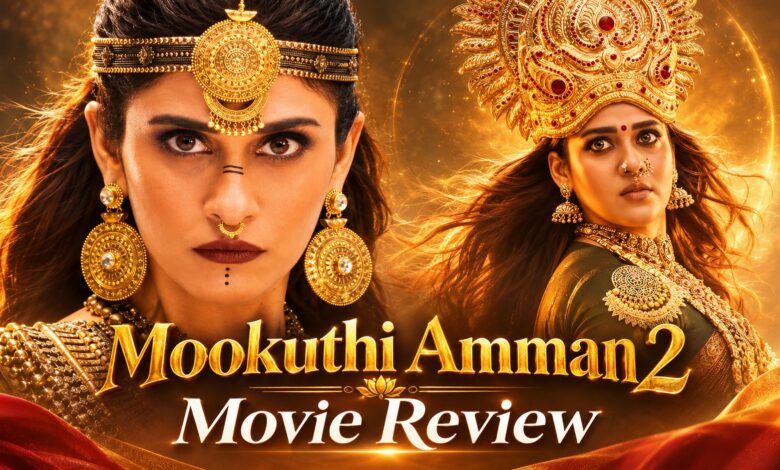
Nayanthara returns to the world of Mookuthi Amman, but the goddess is now surrounded by a very different sort of film. Sundar C’s Mookuthi Amman 2: Maha Sakthi moves away from the 2020 original’s playful social satire and aims for an expansive devotional fantasy, complete with an ancient conflict, several threatening figures, and a battle built around divine power. The ambition is visible. So is the difficulty of turning all those ingredients into an engaging screenplay.
This Mookuthi Amman 2 movie review looks at why the star presence and the later devotional passages offer some satisfaction, while the familiar writing and uneven execution hold the film back.
🎞️ Movie Details
Movie: Mookuthi Amman 2: Maha Sakthi
Language: Tamil
Genre: Devotional fantasy, thriller, and commercial action
Cast: Nayanthara, Regina Cassandra, Duniya Vijay, Urvashi, Yogi Babu, Garuda Ram and Sunil
Director: Sundar C
Screenplay and dialogues: Venkat Ragavan
Cinematography: Gopi Amarnath
Music: Hiphop Tamizha
Editing: Fenny Oliver
Producer: Dr Ishari K. Ganesh
Production: Vels Film International
Release date: 6 November 2026
Runtime: 2 hours 24 minutes
Certification: UA16+ on the theatrical booking listing.
✍️ Story: A Village, a Constable and an Ancient Threat
Shakti, played by Nayanthara, is a police constable whose routine life is disturbed by recurring dreams. A distant village keeps appearing in those visions, even though she has no clear reason to be connected to it. Instead of ignoring the dreams, she seeks a transfer to the place that has been troubling her. Her mother, played by Urvashi, is part of this new chapter in her life.
The village of Mailanji carries a past that reaches back roughly 2,000 years. A battle involving a queen, a child, divine intervention, and dangerous forces has left unfinished consequences. In the present, an old threat gains the opportunity to rise again, and Shakti finds herself drawn into a conflict far larger than the questions that first brought her there.
The central mystery is how an apparently ordinary constable is linked to this history and whether she can face the forces now gathering around her. The film supplies its own answers, but those discoveries are better left to the screen rather than explained in a review.
🔍 Mookuthi Amman 2 Movie Review Analysis
The sequel’s biggest creative choice is also the reason it feels so unlike its predecessor. The first Mookuthi Amman, directed by RJ Balaji and NJ Saravanan, placed a goddess among ordinary people and built much of its humor around superstition, manipulation, and the business of faith. The divine character mattered because she had everyday human problems to respond to. Humor was not an interruption; it was part of the point.
Sundar C takes a different route. Here, faith is expressed chiefly through supernatural struggle, grand imagery, supernatural villains and the eventual assertion of divine strength. The social observations that gave the original a distinctive voice are no longer the main attraction. That shift is not automatically a mistake. A standalone second film has every right to change its tone, especially when its title promises a larger manifestation of the goddess.
The question is whether the new approach develops its own identity. Unfortunately, too much of the film resembles a collection of familiar Amman-movie situations presented with modern digital effects. The story has possibilities, especially in the connection between a present-day woman and an unresolved ancient conflict. Instead of using those possibilities to sharpen the drama, the screenplay frequently depends on explanations, ominous appearances, and repeated demonstrations of power.
At times, the devotional intention comes through. The later portions, particularly the music-led build-up around the divine confrontation, have more urgency than the setup. Yet those moments are working against a film that spends a great deal of time preparing for things the audience can already anticipate.
The First Half: A Promising Question, Uneven Progress
The early setup gives Shakti a straightforward reason to act. A police constable trying to understand repeated nightmares is an accessible starting point, and the move to a strange village offers enough mystery to establish the stakes. Placing an ordinary working woman at the center of a supernatural story also gives the narrative a chance to explore fear, doubt, and personal choice before the larger mythology takes over.
That opportunity is only partly used. Once the film begins arranging its supernatural threats, it grows more interested in announcing danger than in making Shakti’s personal situation increasingly absorbing. The supporting characters arrive, the atmosphere becomes more serious, and the story keeps pointing towards an approaching confrontation. The movement is clear, but not especially surprising.
A commercial fantasy does not need to keep every revelation secret. Viewers know that a film named after a goddess will eventually bring divine power into the conflict. What matters is the route to that moment. Strong character relationships, an unexpected moral problem, or well-placed humor could make familiar events feel lively. Here, many stretches rely on the basic promise that something bigger will happen later.
The result is a first half that can feel more like preparation than a complete dramatic movement. It introduces the right questions but doesn’t always give the audience enough reason to care deeply about the answers. Even the sporadic comedy struggles to lighten the slower passages.
The 2,000-Year Flashback: Scale Without Enough Suspense
The lengthy period material is one of the film’s clearest structural weaknesses. Going back two millennia is a reasonable choice for a story about divine intervention and an ancient adversary. The problem is not the distance in time. It is how much narrative space is devoted to explaining a conflict whose broad outcome has already been suggested.
A flashback should ideally change what we understand about the present. It might reveal a hidden emotional connection, complicate the motives of an antagonist, or reshape the meaning of an earlier scene. Mookuthi Amman 2 has the ingredients for this kind of connection, but the extended historical passages are not consistently gripping enough to justify their length.
The audience is already aware that an evil force was stopped in the distant past and that its return is central to the current conflict. Spending so long detailing that earlier struggle reduces the suspense attached to what follows. The period sequences may be elaborate in ambition, but elaborate does not mean dramatic.
The transitions between eras also lack the easy narrative movement that this type of fantasy requires. Rather than feeling like two timelines continually enriching each other, the film can feel as though one story has been suspended while another is explained. The overall running time would have benefited from a more selective use of that backstory.
Second Half and Climax: The Devotional Energy Finally Arrives
The film becomes more recognizably the large-scale devotional entertainer it wants to be when the supernatural conflict moves towards its resolution. The second half puts more emphasis on divine imagery, music and the larger confrontation promised by the premise. For viewers who enjoy traditional Amman films, this change supplies a more familiar kind of satisfaction.
The appeal here is not that the plot suddenly becomes unpredictable. It remains a recognizable contest between threatening forces and a divine protector. The difference is that the film begins to deliver the heightened mood it has spent so long advertising. The devotional song and the build-up around the climax provide a clearer sense of occasion than many of the preceding scenes.
There is still a considerable gap between the intention and the finish. The action relies heavily on visual effects, and not every image supports the weight of the moment. Some scenes are presented with such volume and intensity that they become tiring rather than stirring. A climactic passage can be emotionally forceful without being continuous noise, and that distinction is not always maintained here.
Even so, this is the section most likely to satisfy audiences who approach the film specifically for the goddess’s commanding screen presence. It gives the film a stronger final impression than its first half earns, although it cannot fully repair the earlier pacing and writing problems.
🎭 Performances: Nayanthara Is the Most Reliable Strength
Nayanthara’s casting remains the principal reason this particular franchise has an identity. She has to occupy two very different registers: a constable troubled by experiences she cannot explain and the larger-than-life presence associated with Mahasakthi. The ordinary and divine aspects require different levels of expression, and she is convincing within that contrast.
As Shakti, the restrained performance suits a woman trying to make sense of disturbing visions. As the goddess, she brings the composure and authority that the film’s grander moments demand. Her screen presence makes the divine portions easier to accept even when the effects and surrounding writing are unsteady.
However, the character on the page is not as interesting as the performer who plays her. A policewoman motivated to investigate her own dreams ought to have room for independent decisions, changing emotions and meaningful exchanges. The film does not develop those qualities as fully as it could. At several points, Shakti appears to exist mainly so the next stage of the supernatural story can unfold around her.
This leaves Nayanthara doing a familiar but important job: lending conviction to situations that the screenplay has not made equally convincing. Her presence provides stability. It does not solve the underlying narrative problem.
Regina Cassandra and Duniya Vijay: Committed Villains, Uneven Writing
Regina Cassandra is given the sort of role that can easily turn into exaggerated posturing if the actor does not commit to it. Her antagonist belongs to the film’s period-fantasy world, complete with heightened emotions and supernatural ambitions. She approaches that material seriously and helps give the opposing side a recognizable personality.
Her performance has greater energy than the routine structure of the conflict. The trouble is that the character’s motivations and presentation do not always come together into a fully persuasive adversary. A threatening costume, a dramatic close-up or a large effect cannot take the place of writing that steadily builds fear.
Duniya Vijay brings a physical presence suited to a commercial villain. His casting makes sense on paper, particularly for a film interested in spectacle and confrontation. Yet the treatment leans too heavily on his appearance and attempts to make him intimidating through forceful presentation. There is less space for the character to become memorable through decisions, dialogue, or a strong clash of personalities.
A film can have several antagonists and still feel focused if they serve distinct dramatic purposes. Here, the range of evil figures sometimes crowds the narrative instead of strengthening it. Regina’s commitment stands out, but the villains as a group would have benefited from clearer priorities and a simpler conflict.
Urvashi, Yogi Babu and the Supporting Cast
Urvashi is a natural fit for the mixture of family emotion and comedy that Tamil commercial cinema often demands. Her relationship with Shakti gives the story a human connection outside its divine mythology. She is capable of delivering warmth and humor without making either feel exaggerated, and the film benefits whenever that everyday quality is allowed to register.
The writing, however, does not give her enough consistently strong material. A more developed mother-daughter relationship could have made the supernatural conflict matter on a personal level. Instead, the story’s attention is regularly pulled towards the next villain or effects-heavy development.
Yogi Babu has an even more difficult task. His presence suggests comedy will provide relief from the serious fantasy material, but the jokes are neither frequent enough nor well integrated enough to do that. Much of his comic space feels separate from Shakti’s central journey.
Sunil, Garuda Ram, and the other supporting performers add faces and threats to the world, but their accumulation does not necessarily make the film richer. Some have limited room to build an impression beyond the familiar traits assigned to them. The number of recognizable actors is greater than the number of thoroughly developed roles.
🎬 Sundar C’s Direction and Screenplay
Sundar C has experience balancing horror, humor, fantasy, and family-friendly commercial ingredients. That makes Mookuthi Amman 2 an interesting test of his strengths. The chosen material offers opportunities for both spectacle and playful entertainment, but this time the balance does not come naturally.
The screenplay by Venkatt Ragavan takes a basic good-versus-evil framework and expands it across two timelines. There is no shortage of material. If anything, the film has too many moving parts for the depth it gives them. Individual threats, past events, comic episodes, and divine action are assembled without a consistently satisfying build-up.
The central structural problem is that the stakes are repeatedly expressed through scale. A more imposing villain, a bigger confrontation, or a longer mythological explanation is treated as a way to intensify the story. Yet emotional stakes need attention too. The film rarely finds a relationship or dilemma strong enough to make the ancient conflict feel newly personal.
Sundar C’s direction occasionally brings the intended devotional grandeur into view, especially towards the end. But a director’s command of commercial ingredients is also measured by what can be left out. This film needed sharper choices about which characters mattered, which details required explanation, and when a scene had already achieved its purpose.
Comedy: The Wrong Break at the Wrong Time
Comedy is among the most disappointing ingredients because its placement works against the mood the film is trying to create. In Sundar C’s more successful genre entertainers, humor often runs alongside fear or suspense. It gives the audience a change of pace while keeping the story moving. Here, long serious passages are followed by a conspicuous comic diversion.
A sequence involving Yogi Babu’s character arrives when the later conflict should be gathering momentum. Rather than easing tension naturally, the film seems to stop its main business for an extended stretch of jokes. By that point, the audience has been asked to take divine danger and ancient revenge seriously, so an unrelated comedy passage feels particularly awkward.
This is not a complaint that devotional cinema must remain solemn. Humor can make divine characters more approachable, and the original film proved how useful it can be. But the jokes need to emerge from people and situations already worth following. A comic detour that interrupts a major build-up has to be exceptionally funny to justify itself. This one does not offer enough in return for the time it takes.
⚙️ Music, Cinematography, Editing and VFX
🎵 Hiphop Tamizha’s Music and Background Score
Hiphop Tamizha’s contribution has two competing effects. The devotional song near the climax supplies the kind of lift the film has been aiming for, and the background score supports Nayanthara’s larger-than-life presentation. These are important strengths for a project that places faith and divine power at the center of its entertainment.
Elsewhere, the soundtrack’s intensity can become a problem. The score is often louder than the emotional substance of a scene requires, creating pressure rather than feeling. The musical high points work best when connected to a clear moment of devotion or dramatic release. Constantly pushing the sound to maximum force makes those occasions less distinct.
📹 Gopi Amarnath’s Cinematography
The film’s photography helps distinguish its contemporary setting from the historical and supernatural material. There are visually appealing passages, especially when lighting, framing, and the scale of the environment work together to support the mythological tone. The climactic devotional staging benefits from this sense of presentation.
The more troublesome moments come when an ambitious camera setup or effect draws attention away from the action itself. Some fast-moving sequences lack the clarity needed to make them involving. The unevenness matters because a fantasy film asks viewers to believe in spaces and events that are already far removed from reality.
✂️ Editing and the Film’s Rhythm
Fenny Oliver’s editing has the difficult job of joining a present-day mystery, a substantial period story, and a late supernatural confrontation. The film’s uneven flow isn’t due to editing alone; much of it stems from how the scenes are written and arranged. Still, the overlong historical explanation and extended comic interruption make the final cut feel less disciplined than it should.
At 144 minutes, the film is not unusually long by commercial Indian cinema standards. It feels long because the narrative often spends time confirming what has already become clear. Several passages could be trimmed without sacrificing the premise or the later spectacle.
🖥️ Visual Effects and Action
The biggest visual problem is inconsistency. Some wider fantasy compositions communicate the intended scale, but other computer-generated elements are conspicuous enough to weaken the illusion. In a story where divine and demonic powers are central, that matters more than it would in a film using effects only for occasional decoration.
The large battle passages deserve credit for attempting an expansive world, yet their impact is reduced whenever the digital imagery fails to blend convincingly with the action. Good fantasy effects are not just about displaying impossible things. They must help those things feel important and believable within the film’s own rules.
Does the Film Work as an Amman Entertainer?
The traditional Amman-film format has always offered a useful combination: a vulnerable human situation, an unmistakable threat, and a goddess whose intervention carries both emotional and spiritual meaning. Such stories can be simple without being empty. Their force often comes from how clearly the divine presence is connected to human suffering or injustice.
Mookuthi Amman 2 understands the visible ingredients. It has ominous figures, elaborate spiritual imagery, a threatened community, and a central female divine force. Its more successful moments create the ceremonial atmosphere that followers of the genre may be looking for. The late musical passages in particular give the film a devotional character beyond ordinary action spectacle.
What is less convincing is the emotional foundation. The screenplay devotes enormous attention to supernatural mechanics but gives less attention to why the people caught in this conflict matter. The original film could make a point through a conversation or a joke. This one frequently tries to make a point by increasing the scale of the conflict.
That difference explains why audiences seeking a traditional, loud, festival-flavored fantasy may still find something enjoyable here, while viewers wanting sharp writing or the 2020 film’s warmth will be less satisfied. The film offers the outline of a devotional experience more consistently than it offers persuasive drama.
👍 Positives
- Nayanthara remains convincing as both the troubled constable and the commanding divine presence.
- Regina Cassandra commits fully to a demanding supernatural antagonist role.
- The devotional song and climactic build-up provide some long-awaited energy.
- Urvashi brings welcome warmth to the human side of the story.
- Selected fantasy compositions communicate the scale the makers are aiming for.
👎 Negatives
- The familiar screenplay gives the principal characters and conflict too little depth.
- The extended historical portions slow the pace instead of building suspense.
- Yogi Babu’s comedy interrupts the serious second-half momentum.
- Uneven CGI and unclear action imagery weaken the supernatural world.
- The background score can become overpowering, especially in already busy sequences.
✅ Verdict: Who Should Watch Mookuthi Amman 2?
Mookuthi Amman 2: Maha Sakthi is a mixed devotional fantasy with more ambition than control. Nayanthara provides the film’s most consistent reason to stay engaged, Regina Cassandra gives the opposition some conviction, and the later devotional passages offer the spectacle that fans of traditional Amman cinema may appreciate. But the screenplay rarely surprises, the flashback is stretched too far, and the comedy arrives at precisely the wrong time.
The result has worthwhile moments. It is simply much less satisfying as a complete film than those moments suggest. Viewers who mainly want a grand, music-heavy divine confrontation may find it a passable one-time theatrical watch. Anyone returning for the first film’s humor, human connection, or social bite should keep expectations modest.
⭐ CinemaRumble Rating: 1.75/5
📝 Review summary: Nayanthara’s assured divine presence and a spirited late devotional stretch cannot fully overcome a predictable story, distracting comedy and inconsistent visual effects.
▶️ Watch the Official Tamil Trailer and Teaser
Planning a theatrical watch? Check Mookuthi Amman 2 Chennai showtimes and book tickets on BookMyShow.
For the release certification, see CinemaRumble’s earlier Mookuthi Amman 2 censor update.