
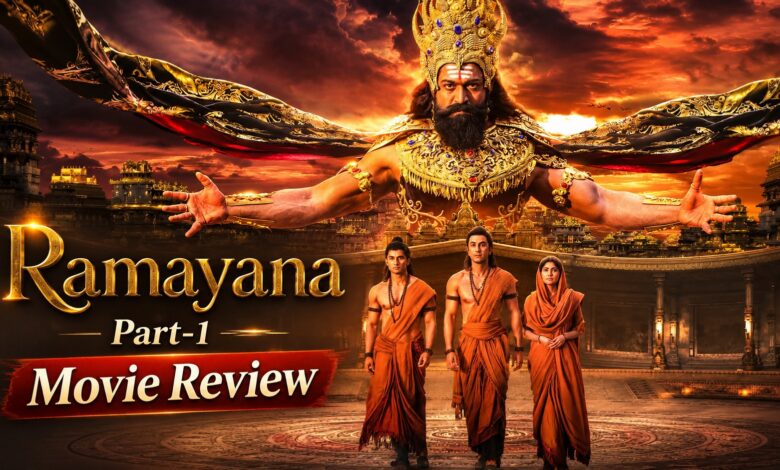
The familiar story is not the biggest challenge facing Nitesh Tiwari’s Ramayana: Part 1. Nearly everyone walking into a screening already knows why Rama leaves Ayodhya, why Ravana matters, and where this journey is heading. The challenge is to make those events feel alive again, rather than treating recognition as an emotion in itself.
This Ramayana movie review looks at how the version balances mythology, character drama, and large-scale action. The result is an ambitious, often absorbing first chapter whose most persuasive character is surprisingly not its hero.
There is a great deal to admire in the visual imagination, particularly whenever Lanka enters the picture. Yash gives Ravana authority beyond the usual loud villain introduction, Sai Pallavi brings dignity to Sita, and the big action passages have real thought behind their designs. Yet the family drama in Ayodhya is less consistently engaging. A film can look enormous and still struggle to make a simple farewell hurt. That difference between spectacle and emotional connection defines this first installment.
🎞️ Movie Details
Movie: Ramayana: Part 1 (2026)
Genre: Mythological drama, fantasy, and action
Director: Nitesh Tiwari
Screenplay: Shridhar Raghavan and Nitesh Tiwari
Main cast: Ranbir Kapoor, Sai Pallavi, Yash, Ravie Dubey, Shobana, Arun Govil, Lara Dutta and Rakul Preet Singh
Music: A. R. Rahman and Hans Zimmer
Cinematography: Pankaj Kumar and Mahesh Limaye
Editing: Huzefa Lokhandwala
Producer: Namit Malhotra; Yash is a co-producer
Production: Prime Focus Studios and Monster Mind Creations, in association with DNEG
Tamil theatrical runtime: 3 hours 15 minutes
Theatrical release: 5 November 2026
✍️ Story: A familiar epic told in two worlds
The film opens with Ravana (Yash), whose determination to secure a stronger future for the Asuras drives him toward extraordinary power. His mother, Kaikesi (Shobana), is central to that motivation. Lanka is not introduced merely as the enemy kingdom waiting at the other end of the story; the film spends time establishing the person who will rule it.
In Ayodhya, the conflict is far more intimate. Rama (Ranbir Kapoor) is expected to inherit the kingdom, but a promise made by his father Dasharatha (Arun Govil) changes his future. Kaikeyi’s (Lara Dutta) demand sends him into fourteen years of exile. Sita (Sai Pallavi) and Lakshmana (Ravie Dubey) refuse to let him face that life alone.
From there, duty, loyalty, and temptation begin to pull the characters in different directions. The first part covers major episodes from the well-known epic while preparing the larger confrontation that lies ahead. The important question is not what will happen, but whether this screen version gives the people involved enough life of their own.
🔍 Ramayana Movie Review: A huge canvas, uneven emotional weight
The decision to begin with Ravana is one of the screenplay’s smartest choices. Instead of opening with a familiar royal introduction and leaving the antagonist for later, the film gives its darker figure a grievance, a family bond, and a sense of ambition. His rise is presented through action and supernatural imagery, but the driving idea is understandable: he wants power because he believes his people have lived without it. That does not make his later choices acceptable. It does make the character dramatically interesting.
The energy changes when the narrative moves to Ayodhya. Here, the film has to explain succession, family obligations, and the consequences of an old promise. These are central to Rama’s life, but several scenes rely on the importance that viewers already attach to the characters. A father’s distress, a mother’s decision, and a prince’s departure are all meaningful events. Their meaning is not always developed through the everyday relationships that should make them painful.
That is a crucial weakness in an adaptation with such a long runtime. The audience knows that Rama is loved by his people. The film is less interested in showing the small interactions that would make that love convincing to someone encountering the story for the first time. When a crowd reacts to his departure, the scale of the response is clear; the personal reasons behind it are thinner.
It would be unfair, however, to call every quiet stretch unnecessary. An epic cannot remain at battle speed for three hours. The marriage and exile material needs room, and restraint is preferable to an endless series of speeches and reaction shots. The difficulty is that some slow passages deepen the characters, while others simply prolong information that has already been delivered. The film is strongest when it knows the difference.
The later stretches recover considerable momentum through the forest journey, shifting dangers and a more imaginative approach to action. By then, the story is operating in the space where this adaptation is most comfortable: familiar incidents reconstructed with a new visual language. Not every scene requires a twist. Sometimes a fresh piece of staging is enough to make a known episode interesting again.
🎭 Yash as Ravana: The film’s richest character
Yash benefits from the most developed character introduction in Part 1, but the strength of the role cannot be reduced to star presentation. Ravana has pride, hurt, anger, and political ambition, often sitting beside one another. His power is frightening because he can appear thoughtful before becoming dangerous. A pause before an order can say more about authority than another shout.
The treatment of his ten heads is a particularly clever dramatic idea. They do not function only as a display of computer graphics. Their different responses give form to conflicting thoughts, allowing Ravana’s own nature to argue with itself. It is an effective way to translate a famous mythological image into something that works for cinema. Yash has room to shift tone and expression across those exchanges.
There are occasions when the direction pushes his entrance and battle sequences towards familiar hero-elevation filmmaking. The accompanying grand gestures can make a villain’s introduction feel like the arrival of a mass hero. Still, the underlying character has enough motivation to withstand that treatment. The performance is interesting in the spaces between the flourishes, not just during them.
The film also sets up an interesting contrast. Ravana gains power through struggle and force, while Rama is expected to give up power through obedience and conviction. That is a strong foundation for two opposing journeys. The problem is that the writing spends more time explaining what drives Ravana than what makes Rama’s sacrifices emotionally costly.
🎭 Ranbir Kapoor as Rama: Restraint is right, but writing matters
Ranbir Kapoor does not approach Rama as a conventional action-film hero. He is composed, courteous, and comparatively quiet, a choice that makes sense for a character whose conduct matters as much as his strength. His handling of confrontations that could easily become aggressive is among the more convincing aspects of the portrayal. The performance avoids turning every moment into a declaration of greatness.
The challenge is not simply whether Ranbir looks the part. Rama is someone viewers are asked to admire, but admiration should grow out of what the screenplay allows him to do and feel. When his decisions are framed primarily as expressions of duty, the man making those decisions can become distant. The idea of dharma matters; repeating it does not automatically dramatize the difficulty of living by it.
There are glimpses of a more engaging Rama in his quiet reactions, his restraint with other characters, and the way resolve gradually replaces uncertainty. Those moments suggest a worthwhile character arc. Yet the film could spend more time with his doubts, his affection for his family, and his bond with Lakshmana. Such scenes would not reduce the hero’s dignity. They would make his dignity feel earned.
You can appreciate Ranbir’s control and still find the central character less involving than Ravana. Yash has more dramatic turns available to him, while Ranbir must operate inside a narrower emotional range. That imbalance is as much a screenplay issue as a performance comparison. This first installment gives Rama a strong moral position, but not always the same dramatic presence.
🎭 Sai Pallavi, Ravie Dubey and the supporting cast
Sai Pallavi’s Sita is presented with a welcome sense of agency. She is not simply a figure placed beside Rama to express devotion. Her choices, composure, and ability to respond to danger help give her a personality within a story that is often told through the actions of men. The performance is measured rather than excessively ornamental, which suits the character.
Her relationship with Rama has affectionate passages, though some of their conversations would benefit from more individual detail. Their importance to one another is never in doubt within the epic. What is less fully explored is what makes them a distinctive couple beyond their established place in it. A few more moments of spontaneous warmth could have helped the romantic and emotional sections.
Ravie Dubey is a genuine asset as Lakshmana. His quicker replies and less ceremonial manner give the family scenes some welcome movement. He can be loyal without sounding permanently solemn, and the occasional wit does not feel like a separate comedy track. In a film so concerned with respect and devotion, that more immediate temperament makes Lakshmana easy to connect with.
Shobana brings striking authority to Kaikesi. The role establishes why Ravana’s personal rise is tied to a wider cause, and her controlled bearing carries much of that early conviction. Arun Govil’s appearance as Dasharatha also brings an unusual connection with earlier screen memories of the epic, but the casting has value within the film as well. His fatherly anguish anchors the exile passages, even when the surrounding treatment becomes heavy.
Lara Dutta’s Kaikeyi and Rakul Preet Singh’s Shurpanakha contribute to turning points that demand both conviction and restraint. Vivek Oberoi is effective in his action-oriented material, while the limited use of some other supporting figures shows how much has been compressed. A cast this large cannot give every character a full journey, but the people closest to Rama need more breathing space than they sometimes receive.
🎬 Direction and screenplay: A difficult adaptation problem
Nitesh Tiwari and the writers face a choice no single film can solve neatly. The Ramayana exists in several literary and regional traditions, including versions deeply familiar to Tamil audiences. A screenplay cannot include every episode, every interpretation, and every supporting character. It has to choose a path, build transitions, and give newcomers enough context without repeatedly explaining what many Indians already know.
Part 1 generally makes sensible choices about which major events to retain. Its structure avoids becoming a complete illustrated retelling of every chapter. The issue is less what the team omits than what it does with the time it keeps. An incident can be covered quickly if its significance is clear. An emotional scene cannot be rescued simply by letting it continue for several minutes.
The palace portion reveals that tension. The political and family conflict is understandable, but the reasoning behind certain changes of heart can appear too convenient. The reactions of relatives and subjects are often presented at an intensity the preceding scenes have not fully prepared for. In places, the filmmaking resembles a television serial enlarged for a cinema screen, especially when close-ups and pauses insist on an emotion already obvious from the situation.
The more successful writing choices give familiar characters specific motives or behaviors. Ravana’s relationship with his mother is one example. Sita’s intelligent response to a difficult situation is another. Lakshmana’s informal temperament is a third. These details make characters active, rather than merely placing them at the right point in a famous tale.
⚙️ Visual effects and production design: Where the money becomes imagination
A large production budget is not automatically visible quality. Expensive digital worlds can feel strangely empty when everything is polished to the same degree. Ramayana avoids that problem in several significant passages by building action around the design of a place or object, not merely surrounding actors with effects.
The Pushpaka Vimana is a good example. Its layered, opening structure gives the action involving Jatayu a distinct geography. Movement around those sections, changes of position and shifts in perspective make the confrontation more than a repeated exchange of digitally enhanced blows. The design matters because the sequence uses it.
Likewise, small visual decisions can be more persuasive than a vast landscape. An image of conflict reflected in an eye, or the practical question of how a warrior’s arrows are replenished, shows attention to how this fantasy world functions. Such touches help bridge the gap between spectacular images and a believable chain of action.
The production design also supplies an identity to the different worlds. Lanka’s grandeur and Ayodhya’s ceremonial spaces have different dramatic purposes. Costumes, weapons, and decorative details are important because these are places where viewers must believe characters live, make decisions, and carry responsibilities. The best passages make that imagined environment feel usable rather than merely expensive.
Not every effect meets the same standard. Some creatures look synthetic, a few crowded shots are hard to read, and certain battles settle for conventional impact poses. At times, the monumental settings appear to overwhelm the people standing inside them. These flaws stand out because other sequences show how imaginative and coherent the visual work can be.
💥 Action sequences: The Jatayu episode is the standout
The action works best when it has a clear idea beyond showing the size of a conflict. Early battles establish the power available in this world, but several rely on familiar combinations of charging figures, sweeping camera movements, and heightened introductions. They communicate force without always producing tension.
The encounter involving Jatayu stands apart because its staging gives viewers something to follow. The unusual structure of the airborne vehicle, the positions of the characters, and the changes in direction create a sequence with an identity of its own. The spectacle is not detached from the story: the physical geography makes the struggle understandable.
The forest action involving Rama, Sita and Lakshmana also offers a useful change of pace. Instead of presenting heroism only through a single person’s grand entrance, it allows the group to respond to danger together. This gives the adventure portions more movement and reinforces the practical bond between the central characters, even where the quieter writing has left that bond underdeveloped.
These sequences show the film’s potential. When performance, production design, movement and visual effects serve the same idea, a familiar episode can feel newly engaging. The weaker action scenes are not disastrous, but they make clear how much better the film becomes when it stops using sheer size as its principal attraction.
🎵 A. R. Rahman and Hans Zimmer: Powerful moments, mixed consistency
The collaboration between A. R. Rahman and Hans Zimmer is one of the film’s major attractions. The score has an enormous range to cover: intimate family decisions, a wedding, devotional imagery, Ravana’s ascent and battles that move across fantastical locations. The music needs to connect these very different moods without making every scene sound like a climax.
It succeeds most clearly when the arrangement grows out of the immediate dramatic situation. The wedding material has room for melody, while the darker, larger passages can accommodate a stronger orchestral presence. The music accompanying some of Ravana’s scenes and the Jatayu action is particularly effective because the images already have a strong rhythm and direction.
There are weaker passages too. Some cues underline an emotion that is already apparent, and the louder material does not always have a distinctive tune or dramatic purpose. A grand score cannot supply the emotional relationships the screenplay has not established. When music becomes an instruction to feel something, rather than a response to what the characters have earned, it can make a slow passage feel even longer.
It is tempting to divide every Indian-flavoured passage under Rahman and every orchestral flourish under Zimmer. That would be too simplistic without a verified cue-by-cue breakdown. What matters for the review is the overall effect: the collaboration produces memorable stretches, but the soundtrack is not consistently as expressive as the scale of the production might lead one to expect.
✂️ Pacing, editing and the three-hour-plus runtime
At 195 minutes, Ramayana: Part 1 needs more than the audience’s affection for its subject to justify its length. The opening sections move with purpose because they introduce a conflict, establish power, and keep changing the situation. The Ayodhya family passages then ask for patience without always adding enough character detail in return.
Some scenes appear designed to preserve every reaction to an important decision. That can turn a scene into a succession of pauses rather than an exchange between people. A tighter cut would not necessarily remove the quiet moments; it could give those moments more distinction by taking away the repetition around them.
The later action passages benefit from clearer objectives and stronger visual invention. They also expose a peculiar imbalance: the scenes involving Ravana can feel more dramatically immediate than stretches focused on Rama, even though Rama’s journey is the center of the epic. The film finishes this chapter with enough direction to create interest in what follows, but the first part could have earned that anticipation with a firmer emotional foundation.
Whether the runtime feels comfortable will depend partly on what draws a viewer to the film. Anyone most interested in seeing familiar episodes imagined at this scale has much more to enjoy than someone looking primarily for a deeply felt family drama. The best version of this adaptation would not make audiences choose between those pleasures.
🎥 Should you watch Ramayana in 2D, 3D or IMAX?
The film is clearly designed with premium-format presentation in mind. Forest depth, vast interiors, layered action, and flying movement offer plenty of material for a good 3D or IMAX screen. A strong sound system is particularly useful during the battles and larger musical cues. If you enjoy epic fantasy on the biggest possible canvas, that is a sensible way to experience it.
But screen quality is more important than the format label. A dim 3D presentation with uncomfortable glasses may be less enjoyable than a bright, sharply projected 2D screening with clean sound. The quieter family material also depends on being able to see expressions clearly, not just on the ability to appreciate effects work.
For families, the story is familiar, but that does not mean every battle image will suit every child. Some violence and threatening imagery may be intense for younger viewers. Parents who are sensitive to that material should make their own call rather than assuming that mythological subject matter guarantees a gentle film.
👍 What works in Ramayana: Part 1
- Yash’s Ravana has a memorable introduction, a coherent motivation, and room for contrasting emotions.
- Sai Pallavi and Ravie Dubey give Sita and Lakshmana presence beyond their conventional functions in the epic.
- Jatayu’s action sequence combines strong visual design with legible staging instead of depending only on digital scale.
- Lanka’s visual world and the production design often make the mythology feel physically imagined rather than generically decorated.
- The final movement gives the two-part story a clearer sense of purpose after an uneven middle stretch.
👎 What holds the film back
- Rama’s personal relationships are sometimes assumed rather than sufficiently developed on screen.
- The Ayodhya portions can lean on extended reactions and ceremonial emotion instead of revealing character through behavior.
- The pacing is uneven, with a three-hour-plus runtime that could have used firmer editing.
- Music and CGI quality vary, especially when loud scoring or synthetic creatures distract from the action.
- Ravana feels more fully written than Rama, leaving the film’s dramatic balance tilted towards its antagonist.
✅ Verdict: A worthwhile big-screen epic with room to grow
Ramayana: Part 1 makes a convincing case for retelling an extensively familiar epic on a modern cinema screen. It finds fresh visual possibilities in the ten-headed Ravana, the airborne action and the worlds of Lanka and Ayodhya. Yash is the strongest presence, and the supporting performances add personality where the writing gives them space. The Tamil version is also handled with welcome care.
What holds the film back from its full potential is the uneven attention to spectacle and emotional detail. Rama’s sacrifices deserve as much dramatic preparation as Ravana’s ambition. Some family scenes ask viewers to bring their feelings from earlier tellings rather than building them afresh. Even with those reservations, the scale, several impressive performances, and imaginative action make this a worthwhile theatrical watch, preferably in a well-equipped cinema.
⭐ CinemaRumble editorial rating: 3.5/5
📝 Review summary: A visually ambitious presentation led by Yash’s compelling Ravana and inventive action, held back by uneven pacing and underdeveloped emotional relationships.
For more coverage, explore CinemaRumble’s Tamil movie reviews.
▶️ Official Tamil Trailer and Rama Teaser
🎟️ Ramayana Tamil tickets
Check current Ramayana Tamil 3D showtimes and book tickets in Chennai. Show availability and cinema formats can change.