
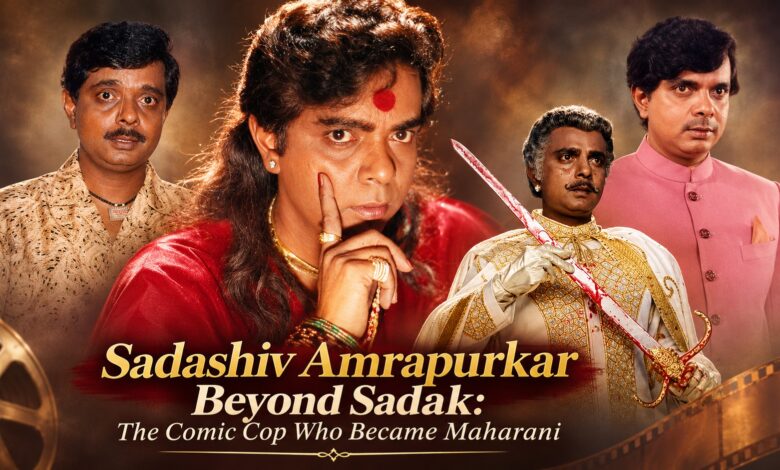
Govind Nihalani went looking for a gangster and found him playing a policeman for laughs. The play was Hands Up, the policeman was Sadashiv Amrapurkar, and the part Nihalani had in mind was Rama Shetty in Ardh Satya. Of all the ways into the Sadashiv Amrapurkar movies that followed, this casting story offers the best clue. The director saw a comedian and recognized the man who could make Om Puri’s police uniform look like no protection at all.
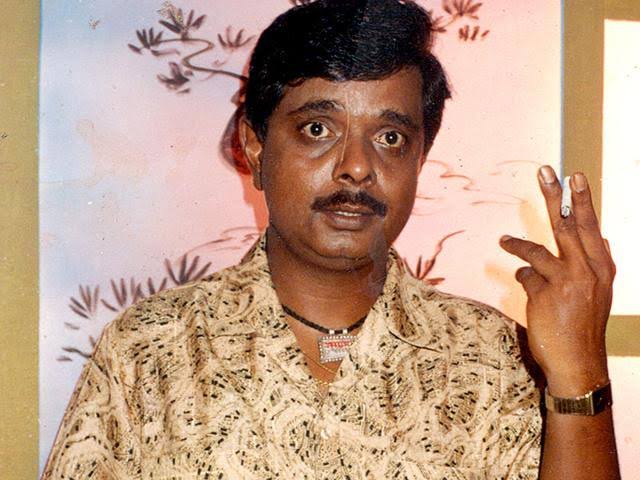
By 1991, Mahesh Bhatt’s Sadak had given Amrapurkar another name: Maharani. More than twenty years later, people were still addressing him by it. Back in Maharashtra, though, some people still remembered him as one of the actors who took a Marathi play on the road to help pay social workers. Why did one role travel so much further than the rest of his work? The answer starts with what he could do for a Hindi film star, but it ends somewhere altogether different: with what a theatre company could do with the price of a ticket.
Before Rama Shetty, there was a stage full of comedians
Hindi cinema encountered Amrapurkar after Marathi audiences had already had time to form their own idea of him. He had acted in Ahmednagar, worked as a theatre director, and appeared in Suryachi Pille alongside Mohan Gokhale and Dilip Prabhavalkar. These are useful names to keep in the picture. The history of an ensemble looks very different when told from the wings than when it begins with the one member a film director took away.
He had also been in films. In Jayoo and Nachiket Patwardhan’s Marathi 22 June 1897, made in 1979, he played Bal Gangadhar Tilak. The date in the title refers to the assassinations of British officers Rand and Ayerst in Pune, not to the year of production. It is an arresting first point of comparison: a performer later associated with the criminals of contemporary Bombay had already appeared in a film about the contested politics of colonial Poona. Ardh Satya gave him his Hindi breakthrough in 1983. It did not give him his first encounter with a camera.
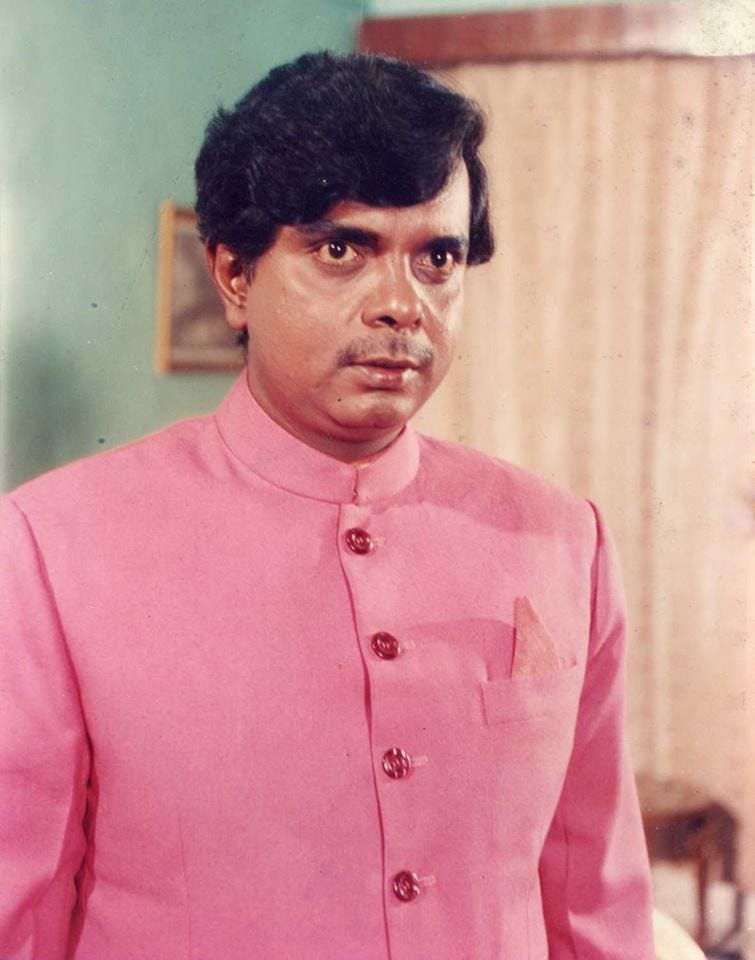
The route from Hands Up to Rama Shetty is unusually well documented because Nihalani told the story himself. Playwright Vijay Tendulkar suggested the actor. Nihalani met him, admitted that he had not seen his stage work, and asked to be invited to a performance. Bhakti Barve was in the play. What caught the director’s attention was the policeman’s comic timing and the concentration in the actor’s eyes. He remembered deciding before the play ended.
That decision was not inevitable. Another director could have watched exactly the same show and carried away the name of a good comic policeman. Nihalani needed the man on the other side of the desk. He understood that timing was not simply a way of landing a joke. It could also make an honest officer wait just long enough to realize who was in charge.
Ardh Satya: the gangster who can afford to be polite
Most screen gangsters have to demonstrate what will happen if a policeman crosses them. Rama Shetty has people who will take care of the matter while he remains a courteous host. When sub-inspector Anant Velankar arrests some of his men, it is the policeman who ends up going to meet the gangster. Everything important about their relationship is there in the direction of travel. Shetty doesn’t have to show up at a police station to explain anything.
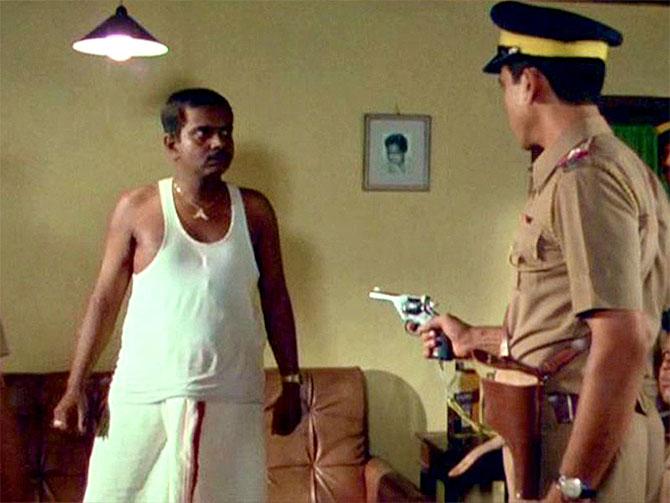
Amrapurkar makes that arrangement feel lived in. Nihalani remembered giving the Kannada-speaking character a close haircut, a lungi and a kurta. There is no elaborate costume to account for his authority. His soft way of speaking does more damage than a bellow would. He can offer assistance to the man who ought to be investigating him and make the offer sound quite reasonable. To refuse becomes a piece of bad manners; to accept would be the beginning of an obligation. The trap has been set with every appearance of hospitality.
Om Puri’s contribution to this effect is enormous. Anant has to carry his anger out of the room; Shetty has the luxury of leaving his behind. Smita Patil’s Jyotsna, a lecturer, allows us to see the policeman in company where a uniform need not determine how two people speak to each other. Amrish Puri, as his father, supplies a different lesson in what authority can do inside a home. Between them, the three relationships prevent the gangster from becoming the convenient explanation for everything wrong with Anant’s world. Defeating one man could never settle all these accounts.
At the 1984 Filmfare Awards, Amrapurkar won Best Supporting Actor for Ardh Satya. Supporting is exactly the right word here. The performance gives Om Puri something specific to push against without diverting the film into a second life story about the don. Nihalani went on to use Amrapurkar as a corporate figure in Aghaat. Even the director who helped establish the gangster image did not regard the actor as wedded to it.
What Amitabh Bachchan and Dharmendra needed from a villain
In Aakhree Raasta (1986), K. Bhagyaraj gave Amrapurkar a different sort of protection: political office. His Chaturvedi is one of the men responsible for destroying David’s family. Amitabh Bachchan plays both David and his son Vijay, a police officer. Where Nihalani makes one policeman struggle against a system, Bhagyaraj splits the emotional argument between two Bachchans. One wants retribution; the other is answerable to the law. Chaturvedi gives both men a reason to act without needing an origin story of his own.
There is a cost to remembering it simply as a clash of male actors. Mary, played by Jaya Prada, is the person against whom Chaturvedi first exercises his power. The film goes on to give father and son the larger share of the story, but the politician’s conduct towards Mary tells us what kind of authority he believes he enjoys. Amrapurkar does not have to look stronger than Bachchan. What matters is that, when it counts, his version of events carries more weight than David’s.
Anil Sharma used that disparity even more openly in Hukumat (1987). Opposite Dharmendra’s policeman, Amrapurkar was Deenbandhu Deenanath, the local power known as DBDN. Sharma later remembered resistance to the casting on the grounds that his villain did not look a physical match for Dharmendra. It is a revealing objection. Nobody needed persuading that Dharmendra could win a fight. The job of his opponent was to make the audience understand why a fight had become necessary, and why winning it would count for more than knocking down one man.
DBDN can stand for a whole arrangement of fear and obedience. Even the bureaucratic sound of those initials gives him something of an institution. Hukumat was a blockbuster, and Sharma cast Amrapurkar again: as Durjan in Elaan-E-Jung (1989), with Dharmendra and Jaya Prada, and as Raja Jaichand in Farishtay (1991). The latter’s ensemble included Vinod Khanna, Sridevi and Rajinikanth. In a cast that is crowded with stars, an antagonist who hardly needs introducing buys the film time. The danger for the actor is that a producer may come to value the time saved more than the other things he can do.
Sharma’s memories also preserve a part of their collaboration no credit sequence could show. He remembered talking literature with Amrapurkar. Nihalani, independently, recalled the actor taking out a book when he had nothing to do on set. These are two colleagues remembering a habit, not a claim that reading made him a better villain. They do give us a more recognizable working actor: somebody who could spend the morning threatening a star and the interval talking to his director about something other than movies.
Sadak: why Maharani’s most frightening line is a refusal
In Mahesh Bhatt’s Sadak (1991), Pooja wants to leave the brothel with Ravi, the taxi driver she loves. Maharani will not let her go. In Amrapurkar’s own account of the scene, what mattered was the pretense of sympathy. Maharani treats the plea as though it were an unfortunate request that the rules of the business will not allow. There is no rule, of course, beyond the one the brothel keeper imposes. Pooja asks for her freedom and gets the tone one might use to turn down a refund.
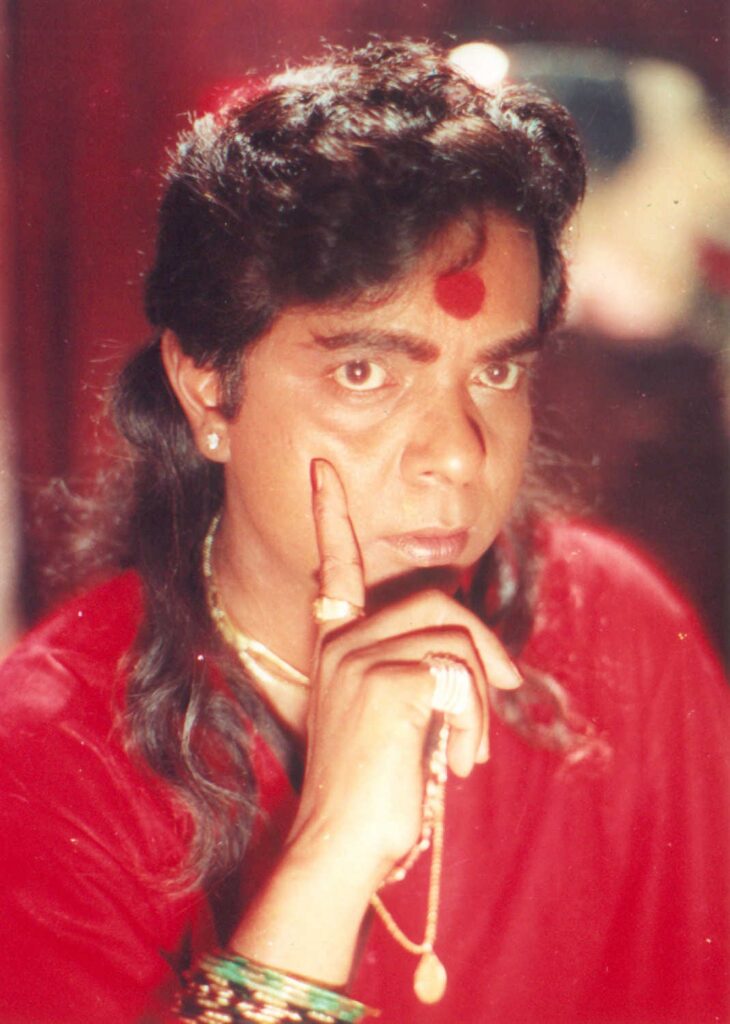
Pooja Bhatt is essential to the scene. She has to plead in earnest, not merely cue the famous answer. Sanjay Dutt’s presence as Ravi gives the couple a possibility of escape, but it cannot give Pooja permission to walk out. The imbalance is sharper than a conventional hero-villain confrontation. Pooja knows exactly what she wants. The person in a position to grant it claims to be powerless. That false note of kindness is a better guide to the performance than the costume by which the character is usually recognized.
Elsewhere, during the pursuit, Maharani addresses the fugitives like children and hums a nursery rhyme. Amrapurkar recalled both the coaxing and the tune. Put that moment beside Rama Shetty offering the policeman a favor. In both cases, the words belong to an ordinary, even affectionate exchange; the person hearing them has very good reason to be afraid. Maharani is far more demonstrative than Shetty, yet beneath the difference in scale the actor is doing something wonderfully consistent. He lets the person with power decide what kind of conversation everyone else is having.
At the 1992 Filmfare Awards, Amrapurkar became the inaugural winner in the villainous-role category. The distinction between the two dates matters: 1991 belongs to the film, 1992 to the award. His earlier trophy recognized how much a supporting actor could give a film. This one recognized a performance by naming its particular function. It was both an honor and a very effective way of fixing one word to his name.
There is also a difference between admiring Amrapurkar’s choices and endorsing all of Bhatt’s. The actor said he had played gender-nonconforming characters in Marathi theatre and welcomed a part that wasn’t there merely to get a laugh. Yet replacing ridicule with terror is hardly the same as giving a hijra character an ordinary human range. The film asks us to fear a trafficker, but it also presents Maharani’s gender expression as something meant to alarm us. The captivity and the threats supply all the horror the story needs. A sari supplies none. A fair retrospective owes the performer credit for the distinction he tried to make and viewers the freedom to question the one the film actually makes.
A song he actually sang, and a reformer he actually played
A playlist of songs from Amrapurkar’s films can give a misleading impression of his musical career. Tumhe Apna Banane Ki Kasam, on T-Series’ channel, belongs here because it sets out the romantic world of Sadak, the very possibility Maharani tries to deny the couple. It is not a Sadashiv Amrapurkar vocal. For one of those, turn instead to Abbas-Mustan’s Agneekaal (1990) and a song with the splendid title Dil Ka Vote Doongi.
Ishtar Music credits both Alisha Chinai and Amrapurkar on the recording, with Pankaj Bhatt as composer and Shyam Raj as lyricist. Here is one occasion when the distinctive voice that directors wanted for dialogue actually belongs in the music credits. It is a better reason to include the number than any claim about its chart position. It also makes a pleasing change from looking for the actor in someone else’s romantic duet: on this recording, you can listen for him.
On Doordarshan, Shyam Benegal used that voice again. Episode 45 of Bharat Ek Khoj casts Amrapurkar as Jyotirao Phule, with Shubhangi Sangvai as Savitri. The Phules’ fight to widen access to education gives their opponents the weight of established custom. The man played by Amrapurkar is now the one who needs other people to stop obeying. For viewers who know his Hindi films, the reversal is worth seeking out in its own right. There was a time when a cinema ticket and a television set could give you quite different answers about what sort of actor he was.
The episode also guards against a sentimental reading of his off-screen politics. He did not become a reformer because he had played Phule, any more than he became a bully because he had played DBDN. What the credit gives us is a corresponding piece of performance history. A director working with Maharashtra’s social history trusted him to embody a man who challenged inherited power. That casting belongs in the record alongside every director who trusted him to embody the man at the top.
Three Sadashiv Amrapurkar movies that complicate the villain label
In Aankhen, he was Inspector Pyare Mohan. The uniform returned, this time in a comedy built around Govinda, Chunky Panday, and the havoc mistaken identity can cause. Watch Ultra’s scene pairing Amrapurkar with Kader Khan rather than a compilation of villains’ speeches. Khan is a rewarding partner because he can carry indignation through a whole exchange. A policeman who cannot settle matters is an ideal person to set opposite him. Instead of patiently waiting for a policeman to realize he is helpless, as in Ardh Satya, Amrapurkar now gets to be part of the confusion himself.
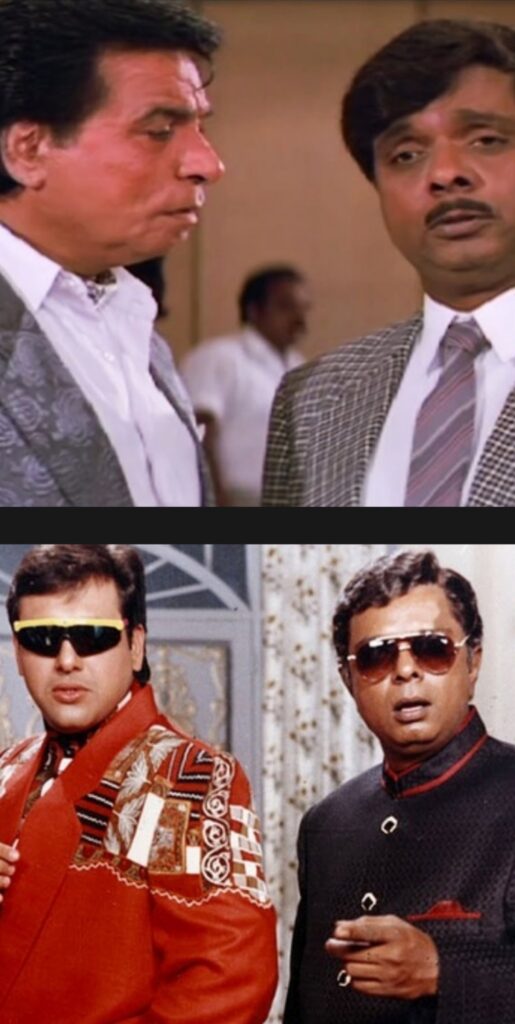
Coolie No. 1 gives him the more satisfying comic assignment. Shaadiram Gharjode, a matchmaker insulted by Kader Khan’s wealthy Hoshiyar Chand, recruits Govinda’s porter Raju to pass for a rich prospective husband. It is easy to recall the film as a Govinda and Karisma Kapoor vehicle and forget whose bruised professional pride sets it moving. A matchmaker is supposed to certify a stranger’s suitability. Shaadiram retaliates by taking the very skill he’s hired for and using it to certify a complete fabrication.
That joke has more bite than a simple exchange of insults. Hoshiyar Chand believes he can tell a suitable groom by how much money the man possesses. Shaadiram understands that the father can only tell how rich someone looks. Amrapurkar gets to run an experiment at the rich man’s expense, and Govinda gets the considerably harder job of living inside it. In Main Toh Raste Se Ja Raha Tha, the Tips song featuring Govinda and Karisma, you get the stars’ share of the pleasure. Go back to the matchmaker afterward, and you find the person who made their unlikely meeting possible.
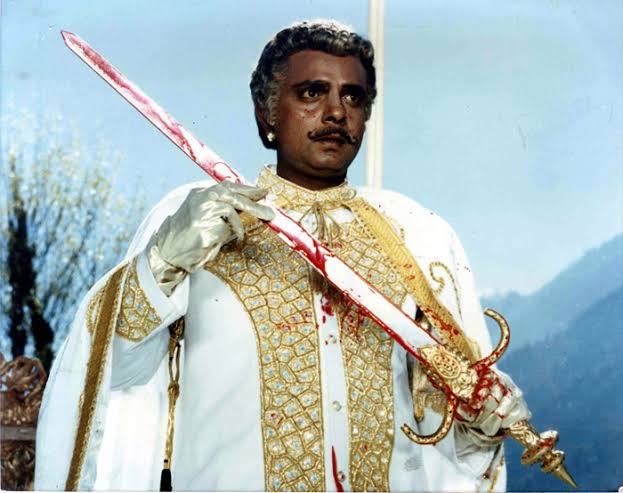
In Ishq, he moves to the other side of the proposed marriage. As Ranjit Rai, he is the rich father of Ajay Devgn’s character; Dalip Tahil plays the other wealthy father. What starts as an extravagant objection to marrying outside their class has real consequences for the two couples, played by Devgn and Kajol, and Aamir Khan and Juhi Chawla. The father who looks ridiculous enforcing a preference can still do harm by enforcing it. Of the commercial roles, this is the one to revisit for the uncomfortable distance between laughing at the man and trusting him.
The father in Vastupurush who refuses to use his influence
Sumitra Bhave and Sunil Sukthankar’s Marathi Vastupurush (2002) makes a particularly good double bill with Ishq. Here Amrapurkar plays the father of Bhaskar, a boy who wants to become a doctor. The family is short of money. His father, a veteran of the freedom struggle, is uneasy with the accommodations that life in independent India seems to demand. The difficulties of getting a son educated test the value of an upright life more sharply than a speech about the nation ever could.
The difference from Ranjit Rai is not just that this father is a good man. It is that his idea of goodness can make life difficult for the people he loves. It would be so much easier for his son if he would call in a favor. Uttara Baokar, playing Bhaskar’s mother, has her own understanding of what the family owes others and of what his education might be for. She is no decorative witness to a man’s nobility. The adult Bhaskar’s vocation owes something to the work his mother imagines for him, not simply to the principles his father hands down.
Amrapurkar is particularly well cast because viewers familiar with Rama Shetty know how persuasively he can play a man who dispenses favors. Here he has to make us understand the person who will not ask for one. Put those fathers and politicians beside one another and the usual division between his serious roles and his comic roles begins to feel less useful. A better question to bring to an Amrapurkar performance is this: what does the character believe his position entitles him to do?
Lagnachi Bedi: what twenty-one performances paid for
One of the best surviving accounts of Amrapurkar’s work outside cinema is not a tribute to him at all. It is a speech Narendra Dabholkar gave about Dr Shreeram Lagoo in Pune in April 2013. Amrapurkar turns up in it as one name among many. That is exactly why it is valuable. Nobody telling the story was trying to prove that a screen villain was secretly a saint. Dabholkar was explaining a practical problem: how could a full-time social worker meet living expenses when the people who most needed that work often could not pay?
The Samajik Krutadnyata Nidhi was intended to help such workers. Dabholkar recalled that Ram Apte of Jalgaon had proposed the fund, that Lagoo was its founding president and that he himself was its founding secretary. At first, Lagoo collected donations from people he met while filming. Dabholkar remembered receiving cheques signed by Jaya Prada and Dharmendra. It is an unexpected second connection between the actors in this story, quite separate from their film credits. In the organizer’s recollection, Lagoo wanted donors to know what they were supporting, rather than simply trust the person doing the asking.
So the company took Acharya Atre’s Marathi play Lagnachi Bedi on tour. Among those Dabholkar named were Amrapurkar, Lagoo, Nilu Phule, Rohini Hattangadi, Reema Lagoo, Tanuja and Bharati Achrekar. His account in Marathi gives a precise figure: twenty-one performances brought in ₹21 lakh after expenses. He then described a different appeal involving students that raised nearly ₹25 lakh. Those sums belong to different efforts. The first was money raised by a company and its audiences, not a personal donation by Amrapurkar.
Think of what a ticket bought in each part of Amrapurkar’s working life. At Hukumat, it bought the satisfaction of seeing Dharmendra face a man who had made himself unanswerable. At Lagnachi Bedi, it paid for an evening with a formidable cast and left something over for people whose work seldom sold tickets at all. The theatre story loses its point when one famous name gets the credit. The whole idea was that performers, paying audiences and workers who might never appear on a stage could do something for one another.
What Snehalaya and the Narmada valley remember
In Ahmednagar, Amrapurkar’s connection with Snehalaya went further than lending his name to a benefit. The organization identifies him as a former trustee. Its own history begins with founder Girish Kulkarni and women in sex work who wanted safer arrangements for their children. Three women from the community became founding trustees. Snehalaya’s work grew to include women and children facing exploitation and families affected by HIV. Amrapurkar belongs in that history, but the women whose requests shaped the institution belong at its beginning.
It is tempting to link this work neatly to Sadak. The film and the organization both bring the lives of women in the sex trade into view. The difference is who gets to speak and decide. The movie puts the desires of two lovers up against one person who controls a brothel. The institution’s own account begins by listening to the mothers who already know what their children need. There is no need to invent a claim that the film caused his involvement, or that his work as a trustee made the film more accurate. Put side by side, they tell us something more useful about the limits of a rescue story.
Amrapurkar was also associated with the Maharashtra Andhashraddha Nirmulan Samiti, the movement against superstition, and with voter-awareness work through Lokshahi Prabodhan Vyaspeeth. For the Narmada Bachao Andolan connection, there is a particularly clear witness. In a 2015 interview, Medha Patkar remembered that he came to the valley. She was talking about how artists could stand alongside communities facing displacement. She did not describe him as the movement’s leader. Showing up in support of people conducting their own struggle was precisely the gesture she thought worth remembering.
Bombay Talkies: one syllable and an actor’s whole education
A small part near the end of Amrapurkar’s career makes an especially good place to finish. In Star, Dibakar Banerjee’s contribution to the 2013 anthology Bombay Talkies, Nawazuddin Siddiqui plays a man offered a tiny role on a film set. His dialogue scarcely amounts to more than a syllable. Amrapurkar appears as a figure from his theatrical past. Satyajit Ray’s short story Patol Babu, Film Star supplied the premise: what is an actor supposed to do when the industry regards the part as too small to matter, and the actor knows it need not be?
Banerjee added a lovely piece of production history years later. Conversations with Amrapurkar about acting, theatre and the history of Bombay fed into the encounter with Siddiqui. The veteran was not simply there to lend a familiar face to a cameo. Something he knew, and could communicate off camera, became part of what a younger actor had to answer on camera. It is hard to imagine a better use of the man Nihalani had found doing farce three decades earlier.
So why does Maharani still come to mind first? Sadak gave an actor with an ear for false kindness a villain whose gentlest words were the most frightening. Filmfare gave the achievement a name; the people who later called him Maharani gave it a life beyond the picture. But a celebrated role is a poor container for a life. It cannot also hold Bhakti Barve’s comic partner, Govinda’s matchmaker, the father who will not trade on his principles, and the man who joined a touring company so that social workers could carry on.
Amrapurkar died on 3 November 2014. To remember him, start with Maharani by all means. Then try Vastupurush, find his Phule on Doordarshan, or read the names on Dabholkar’s list. The surprise is not that a man who played cruel people could be kind. It is how often, in the theatre and in the movies, Sadashiv Amrapurkar made somebody else’s part possible. That was true of Om Puri’s troubled policeman. It was also true of people whose names never appeared on a cinema screen.