Amitabh Bachchan’s Laawaris Revisited: 5 Stories, Hit Songs and the Heera Performance Behind a 1981 Super Hit

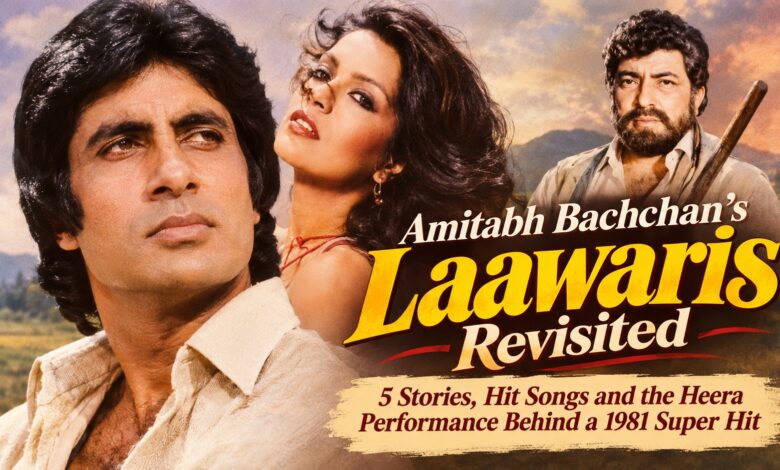
Laawaris arrived on 22 May 1981 when Amitabh Bachchan and Prakash Mehra had already changed the shape of Hindi commercial cinema together. Yet the film is remembered for more than its box-office success. It gave Bachchan one of his most exposed outsider roles as Heera, turned a folk song heard in the Bachchan household into one of the decade’s most recognizable film moments, and carried several production stories that have grown with every retelling.
So why does Laawaris still stand out in the Amitabh Bachchan-Prakash Mehra partnership? The answer lies in the way the film makes social rejection personal. Heera is not merely poor or angry. He is repeatedly judged for not being able to name his parents, and the humiliation attached to his birth becomes the wound behind his defiance. Around that core, Mehra builds a full masala entertainer with romance, comedy, action, melodrama, and songs. The result is a film that could work as a star vehicle while still giving Bachchan a character whose anger has a clear emotional source.
🕰️ Why Laawaris mattered in the Amitabh Bachchan-Prakash Mehra run
By 1981, Bachchan and Mehra were no longer trying to prove that their combination worked. Zanjeer had been a decisive career turning point, while Hera Pheri and Muqaddar Ka Sikandar had strengthened a partnership built around heroes who carried resentment, pride, and emotional damage. Laawaris develops that image in a particularly direct way. Heera’s battle is not only against a villain or a system. It is against the stigma attached to being treated as a man without a legitimate family identity.
Produced and directed by Prakash Mehra, the film featured music by Kalyanji-Anandji and cinematography by N. Satyen. The principal cast included Amitabh Bachchan, Zeenat Aman, Amjad Khan, Raakhee, Ranjeet, Shreeram Lagoo, Suresh Oberoi and Bindu. Its broad masala structure gave Bachchan room to move through several registers within the same film.
That is important when looking back at Laawaris today. The movie is often reduced to “Mere Angne Mein” or to its status as a big Amitabh hit. The more interesting historical point is that the song, the star image, and the identity drama all serve the same central idea: Heera constantly performs strength because society keeps reminding him it doesn’t know where to place him.
🎭 Heera: the performance that holds Laawaris together
Bachchan’s performance as Heera is the strongest reason to revisit the film. The familiar “angry young man” force is present, especially when Heera confronts wealth, privilege, and casual humiliation. But the performance is more varied than the label suggests. Bachchan moves from wounded silence to public defiance, from romantic lightness with Mohini to broad comedy, then back to the need for an answer about his birth.
Heera’s pride and vulnerability coexist. His confrontations rarely feel like displays of dominance alone. When the film humiliates him over his parentage, Bachchan lets the anger feel like a defense against shame rather than a generic heroic pose. That emotional layering separates the role from a simpler revenge hero.
The 1982 Filmfare Awards recognized the performance with a Best Actor nomination for Bachchan. Laawaris also brought a Best Supporting Actor nomination for Suresh Oberoi and a Best Female Playback Singer nomination for Alka Yagnik for “Mere Angne Mein”. Those were nominations rather than wins, an important distinction when the film’s award history is repeated today.
Amjad Khan gives the story another kind of weight as Ranvir Singh, the man connected to Heera’s hidden past. Shreeram Lagoo’s Gangu Ganpat is the damaged adult who raises the abandoned boy and carries information Heera desperately needs. Ranjeet’s Mahendar Singh supplies class arrogance and antagonism, while Zeenat Aman’s Mohini brings the romantic counterweight.
Watch the performance: A full-film upload of Laawaris is available on the verified Revere Records YouTube channel. The channel states that the upload includes the necessary rights and permissions, making it useful for revisiting Heera’s complete arc rather than judging the role through isolated clips.
Laawaris (1981) full film on the verified Revere Records channel. The upload states that it is presented with the necessary rights and permissions.
🎵 The Laawaris songs were not decoration
The Laawaris (1981) songs remain a major reason the film survives in popular memory. Kalyanji–Anandji’s soundtrack includes “Apni To Jaise Taise”, “Kab Ke Bichhde Hue”, “Jiska Koi Nahin”, “Kahe Paise Pe Itna Guroor” and the two strongly remembered versions of “Mere Angne Mein”. Several of these numbers do more than interrupt the story. They extend the movie’s argument about class, belonging and public identity.
“Apni To Jaise Taise” and Heera’s class defiance
Kishore Kumar’s “Apni To Jaise Taise” fits Heera especially well because its attitude is aimed upward. The song turns inequality into performance: the outsider speaks back to people who assume their social position makes them untouchable. Prakash Mehra is credited as the lyricist on Saregama’s official upload, while Kalyanji–Anandji provide the composition. Decades later, the song’s continued visibility was strong enough to spark a copyright dispute when a version was used in Housefull, another sign of how firmly it had entered Hindi film memory.
Official Saregama upload: “Apni To Jaise Taise”, sung by Kishore Kumar.
“Mere Angne Mein” and a song that came from home
“Mere Angne Mein” has the most famous origin story connected to the film. Bachchan has repeatedly described it as a folk song he had heard since childhood and sung during Holi gatherings at home. In a later television recollection, he said his father, poet Harivansh Rai Bachchan, would sing it during Holi. Prakash Mehra heard Bachchan perform the number socially and wanted it in Laawaris, then insisted that Bachchan sing it himself.
That first-person account is more useful than the inconsistent lyricist credits that appear across databases and music metadata. The safest historical description is that Bachchan remembered it as a folk song carried through his family’s Holi tradition, and that Mehra brought that version into the film.
The filmed sequence also shows Bachchan stretching his star persona into deliberately broad comedy as he appears in different female get-ups. It became one of the film’s most recognizable images, even if the humor and gender caricature can land differently for a contemporary audience.
Official Saregama upload: Amitabh Bachchan’s “Mere Angne Mein” version from Laawaris.
“Kab Ke Bichhde Hue” and Zeenat Aman’s Kashmir memory
Zeenat Aman supplied one of the clearest first-person memories from the production when the film completed 42 years. She recalled flying directly from London to Kashmir to make the shoot for “Kab Ke Bichhde Hue”. Prakash Mehra was unwell during that period, she said, and his assistant team stepped in as the song was filmed over two or three days. Her recollection also underlines the working rhythm she shared with Bachchan, whom she described as punctual and professional across their long collaboration.
Official Saregama upload: “Kab Ke Bichhde Hue”, sung by Kishore Kumar and Asha Bhosle.
🎞️ Five behind-the-scenes stories: fact, memory and movie lore
1. Parveen Babi was associated with the female lead before Zeenat Aman
Several later film-history accounts agree that Parveen Babi was signed for the role that eventually went to Zeenat Aman. Some accounts even state that shooting had begun. The exact circumstances of her replacement are less securely documented. Later sources variously describe illness, an absence from India, or other production difficulties.
That makes the distinction important. Parveen Babi’s original association with the project is well supported, but a single definitive explanation for her exit should not be presented as settled history. Zeenat Aman ultimately played Mohini and became central to the finished film.
2. Raakhee played Bachchan’s mother after being his romantic co-star
Raakhee’s casting as Vidya remains one of the film’s striking reversals of familiar screen relationships. She had been paired with Bachchan in films including Kabhi Kabhie, Trishul and Muqaddar Ka Sikandar, yet in Laawaris she plays Heera’s biological mother. The story’s structure places Vidya in an earlier generation, so the adult Heera and his mother do not share conventional mother-son scenes.
The casting therefore works less as a performance pairing and more as star-era shorthand. Audiences familiar with Raakhee and Bachchan as a screen pair were being asked to accept a very different relationship inside the same commercial-cinema world.
3. Jaya Bachchan’s reaction to “Mere Angne Mein” came from Amitabh’s own recollection
One of the most repeated stories about the song concerns Jaya Bachchan. Amitabh later recalled that during a trial screening, she saw the sequence in which he portrayed the different “wives”, got up and left, and then strongly questioned how he could have done it. The anecdote is valuable precisely because it comes from Bachchan’s own later telling.
It should still be treated as a personal memory, not as independently documented production fact. But it reveals something useful about the risk in the number. The sequence that became one of the film’s most famous comic set-pieces did not necessarily look like an obvious triumph to everyone who first saw it.
4. Prakash Mehra did not simply “give” Amitabh a playback song
The origin of “Mere Angne Mein” is sometimes flattened into the claim that the film was designed to make Bachchan sing. His own account is more interesting. He said Mehra had heard him perform the folk number at Holi gatherings and specifically wanted that informal quality. Bachchan even recalled protesting that he wasn’t a trained singer, only for Mehra to insist he sing it as he did at home.
The finished song therefore sits at the meeting point of folk memory, a star’s off-screen persona and commercial film staging. It also reminds us that some of Hindi cinema’s most durable moments were not necessarily created through conventional playback-singing logic.
5. Amitabh Bachchan was unhappy with the final print
Perhaps the best story for understanding how uncertain filmmaking can be comes from Bachchan’s own blog recollection. He wrote that he first watched the final print in Bangalore before distribution and was disturbed by technical glitches. He wanted changes, but by then they were technically impractical, and Prakash Mehra persuaded him to accept the situation.
The irony is that the film went on to become a major success. Bachchan later used the episode almost as a lesson in his own fallibility, saying the audience response made him realize how wrong his judgment had been about the finished film. Unlike vague “on-set secret” stories, this one has a clear first-person source and a useful historical point: even the star at the center of a major release could misread what audiences would embrace.
💰 A genuine 1981 super hit
Laawaris is often casually called a blockbuster, including by Zeenat Aman in her affectionate 42nd-anniversary recollection. Historical trade listings are more specific. Box-office retrospectives classify the film as a Super-Hit, and it was among the biggest Hindi theatrical successes of 1981. Because old collection figures vary by source and accounting method, the commercial verdict is more dependable than trying to force a single exact lifetime number into the record.
Its success is also easier to understand in the context of Bachchan’s extraordinary 1981 run. The same year included Naseeb, Silsila, Yaarana and Kaalia. Laawaris did not create his stardom, but it reinforced how many different tones his star image could carry at its peak.
🏆 Filmfare recognition: three nominations, not a trophy sweep
The film’s awards record is sometimes overshadowed by its popularity. At the 1982 Filmfare Awards, Amitabh Bachchan was nominated for Best Actor, Suresh Oberoi for Best Supporting Actor, and Alka Yagnik for Best Female Playback Singer for “Mere Angne Mein”. The important point is that these were nominations, not wins.
For Bachchan, the nomination belongs to a remarkable run of Prakash Mehra collaborations that repeatedly placed him in major commercial roles. In Laawaris, the recognition makes sense because Heera asks for more than star swagger. The character has to carry the film’s central contradiction: a man treated as socially “without a name” who nevertheless dominates every room he enters.
🌍 From Laawaris to Naa Desam and Panakkaran
The story also moved beyond Hindi cinema. Laawaris was remade in Telugu as Naa Desam (1982), starring N. T. Rama Rao, and in Tamil as Panakkaran (1990), starring Rajinikanth. The central premise could be rebuilt around very different star images and regional audiences.
Readers interested in how such stories travel across industries can explore CinemaRumble’s Remake Special section, which focuses on the relationship between originals, remakes, and localization rather than simply listing titles.
⏳ What still works, and what feels unmistakably of 1981
The strongest part of Laawaris has aged better than some of its packaging. Heera’s need to be treated with dignity regardless of his birth remains easy to understand. The film’s anger at class privilege also gives “Apni To Jaise Taise” and several confrontational scenes a purpose beyond star elevation. Bachchan’s ability to make wounded pride visible remains the key performance strength.
Other elements carry the conventions of their time more clearly. The film’s lengthy masala structure moves freely between intense family melodrama, comic interludes, romance and musical spectacle. Modern audiences accustomed to tighter narrative pacing may find those tonal changes abrupt. “Mere Angne Mein” is culturally important, but its caricature-based humor can also be viewed differently today than it was in the early 1980s.
That doesn’t make the film any less worth revisiting. A Vintage Special works best when it lets an old movie remain part of its era while still asking what survives. In Laawaris, what survives most strongly is not the period styling or even the plot machinery. It is the emotional clarity of a hero who is furious because the world insists that birth determines worth.
✅ Final Perspective: why Laawaris still matters
Laawaris endures because Prakash Mehra found a story that could use every part of Amitabh Bachchan’s 1981 star image without reducing Heera to a collection of “mass” moments. The anger has a personal cause, the songs echo the film’s concerns about class and identity, and the comedy gives Bachchan room to be deliberately unguarded. Even the production memories now attached to the film, from Mehra insisting that Bachchan sing a folk number to Bachchan’s own doubts about the final print, show how much of its identity came from choices that did not look completely safe at the time.
The behind-the-scenes stories are most interesting when they are kept in proportion. Parveen Babi’s early association with the film is well supported, but the exact circumstances of her replacement remain less certain. Jaya Bachchan’s reaction and Bachchan’s technical worries are first-person recollections, not neutral production records. Zeenat Aman’s Kashmir memory is another later recollection that helps illuminate the shoot without turning memory into unquestionable history.
More than four decades later, Laawaris remains a clear example of the Bachchan–Mehra partnership at full commercial strength: a hero’s social wound turned into confrontation, romance, music, comedy and melodrama without losing Heera’s search for dignity.
For more historically focused retrospectives, visit CinemaRumble’s Vintage Specials.