12 Tamil Remakes of Telugu Hits That Struggled to Match the Originals: Julayi to Simhadri

What happens when a Telugu blockbuster travels to Tamil cinema with a new hero, a different comedy team, and an audience that already knows the original? Sometimes it becomes another Ghilli. At other times, the film keeps the plot but struggles to reproduce the rhythm that made its source memorable. This is a closer look at Telugu movies remade in Tamil that attracted particularly sharp comparisons, from Julayi and Simhadri to Happy Days and Kick.
These twelve pairs include commercially disappointing adaptations, mixed-reception entertainers, and a few Tamil versions that still have their admirers. That distinction matters. A less celebrated remake isn’t automatically a box-office disaster, and preferring a Telugu performance doesn’t invalidate the Tamil actor’s interpretation. The more revealing question is what was carried across the language boundary, what was rewritten, and whether the changes made sense.
🔄 Telugu Movies Remade in Tamil: The 12 Original–Remake Pairs
| No. | Telugu original | Tamil remake | Lead actors: original → remake | Relationship |
|---|---|---|---|---|
| 1 | Julayi (2012) | Saagasam (2016) | Allu Arjun → Prashanth | Direct remake |
| 2 | Happy Days (2007) | Inidhu Inidhu (2010) | Varun Sandesh and ensemble → Adith Arun and ensemble | Direct remake |
| 3 | Dhee (2007) | Mirattal (2012) | Vishnu Manchu → Vinay Rai | Direct remake |
| 4 | Varsham (2004) | Mazhai (2005) | Prabhas → Jayam Ravi | Direct remake |
| 5 | Kick (2009) | Thillalangadi (2010) | Ravi Teja → Jayam Ravi | Direct remake |
| 6 | Athanokkade (2005) | Aathi (2006) | Nandamuri Kalyan Ram → Vijay | Direct remake |
| 7 | Aadi (2002) | Jai (2004) | Jr NTR → Prashanth | Direct remake |
| 8 | Simhadri (2003) | Gajendra (2004) | Jr NTR → Vijayakanth | Direct remake |
| 9 | Pataas (2015) | Motta Shiva Ketta Shiva (2017) | Nandamuri Kalyan Ram → Raghava Lawrence | Direct remake |
| 10 | Bhale Bhale Magadivoy (2015) | Ghajinikanth (2018) | Nani → Arya | Direct remake |
| 11 | 100% Love (2011) | 100% Kadhal (2019) | Naga Chaitanya → G. V. Prakash Kumar | Direct remake |
| 12 | Ala Modalaindi (2011) | Yennamo Yedho (2014) | Nani → Gautham Karthik | Direct remake |
🎬 Twelve Originals and What Their Tamil Remakes Changed
1. Julayi (2012) vs Saagasam (2016): Allu Arjun’s Timing Was Hard to Recreate
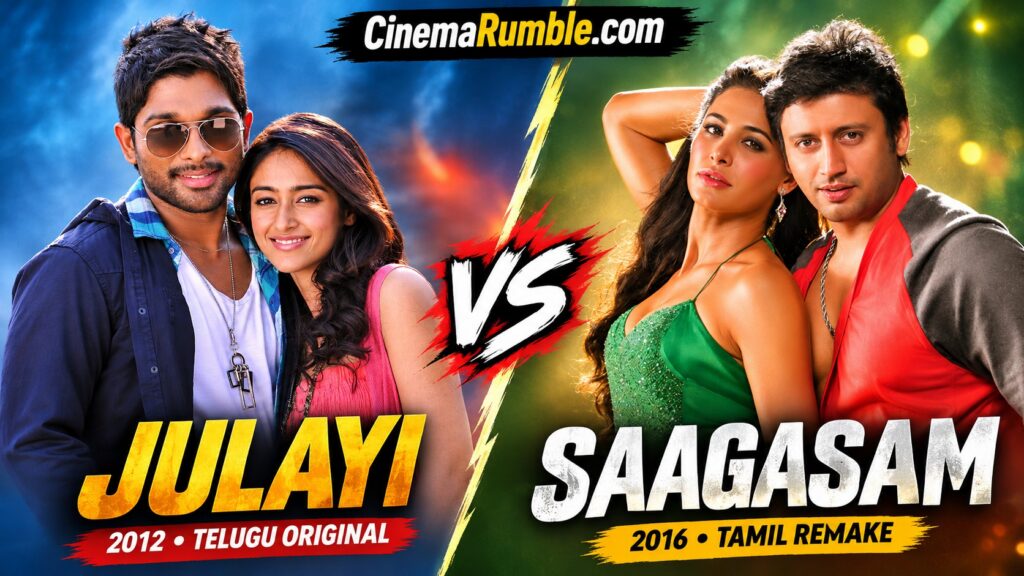
Trivikram Srinivas directed Julayi as a crime-flavored action comedy built around Ravindra Narayan, an intelligent but directionless young man played by Allu Arjun. Ileana D’Cruz is Madhu, Sonu Sood is the criminal Bittu, and Rajendra Prasad provides an important police connection. The opening bank-robbery conflict gives Trivikram room for wordplay, reversals, and comic interruptions; Allu Arjun has to be quick with both his dialogue and physical reactions.
Arun Raj Varma’s Saagasam places Prashanth in the equivalent central role, with Amandha Rosario as the female lead and Sonu Sood returning as the antagonist. Its filmmaking remains unusually close to the Telugu template, and some footage featuring supporting Telugu actors was reused. That makes the shift in comic tempo more noticeable. A witty situation can survive a translation, but its effect also depends on a particular actor’s delivery and the pauses between lines.
Prashanth brings his dancing and action experience to the role, while the new soundtrack by S. Thaman replaces Devi Sri Prasad’s songs. Still, the remake illustrates how recreating incidents is easier than recreating the personality holding them together. Allu Arjun’s controlled cheekiness, rather than the crime plot alone, is what makes Julayi such a useful comparison.
2. Happy Days (2007) vs Inidhu Inidhu (2010): A College Story With Two Different Afterlives
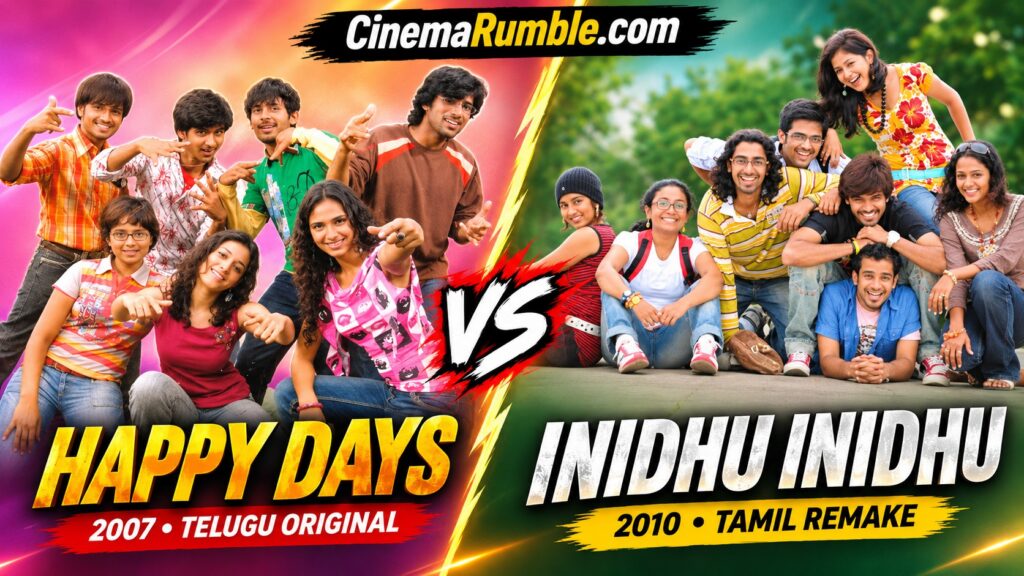
Happy Days was Sekhar Kammula’s affectionate portrait of engineering-college friendships. Varun Sandesh, Tamannaah Bhatia, Nikhil Siddhartha, Sonia Deepti and the wider ensemble made college experiences the center of the film rather than a backdrop for one heroic lead. Its music by Mickey J. Meyer helped give those relationships their emotional continuity. The Telugu film became a major success and received significant awards recognition.
Produced by Prakash Raj and directed by K. V. Guhan, Inidhu Inidhu likewise chose a largely new cast led by Adith Arun and Reshmi Menon. Sonia Deepti returned in a corresponding part, while Mickey J. Meyer also composed for the Tamil adaptation. The new faces made sense for a youthful narrative, although reproducing a very particular ensemble chemistry is a demanding task. Even familiar college events feel different once the performers, dialogue rhythms and cultural references change.
This is an important exception to the idea that every title on such a list was universally rejected. Contemporary Tamil reviews included both reservations and warm praise; some reviewers found it an enjoyable campus film. For viewers attached to the original’s spontaneous atmosphere, however, the comparison can be unforgiving. Happy Days was also separately remade in Kannada as Jolly Days (2008), not through its later Tamil version.
3. Dhee (2007) vs Mirattal (2012): Why Comedy Partners Matter
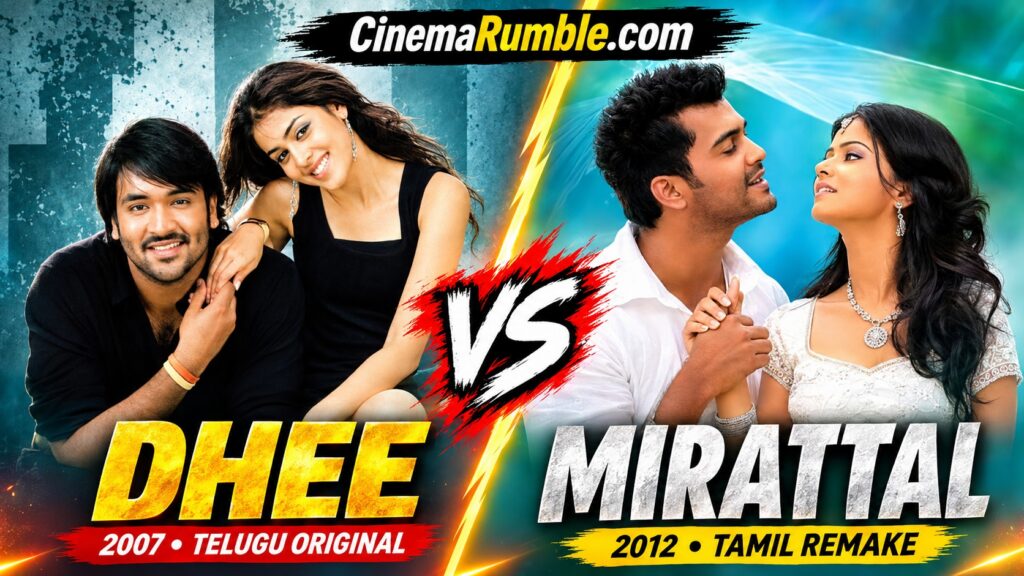
Srinu Vaitla’s Dhee paired Vishnu Manchu and Genelia D’Souza with Srihari, Brahmanandam, and other comedians in a story where romance becomes entangled with a gangster’s household. The plot is familiar, but its pleasure lies in the constantly shifting balance between the cocky hero, intimidating characters, and comic misunderstandings. Brahmanandam’s exchanges became an especially important part of the Telugu film’s reputation.
R. Madhesh reworked the same premise in Mirattal, with Vinay Rai as Babloo, Sharmila Mandre as Deepika, Prabhu in the protective gangster-brother role and Santhanam supplying much of the comedy. The broad story connection is unmistakable, but the supporting performers don’t feel like interchangeable parts. The Tamil screenplay relies on a different comic cadence and more conspicuous action beats.
Calling Mirattal a complete failure oversimplifies its contemporary reception. The comparison is really about the Telugu cast’s distinct chemistry. Dhee is an example of a comedy whose supporting team is as essential to its appeal as the lead pair.
4. Varsham (2004) vs Mazhai (2005): The Romance Was More Than a Rain Motif
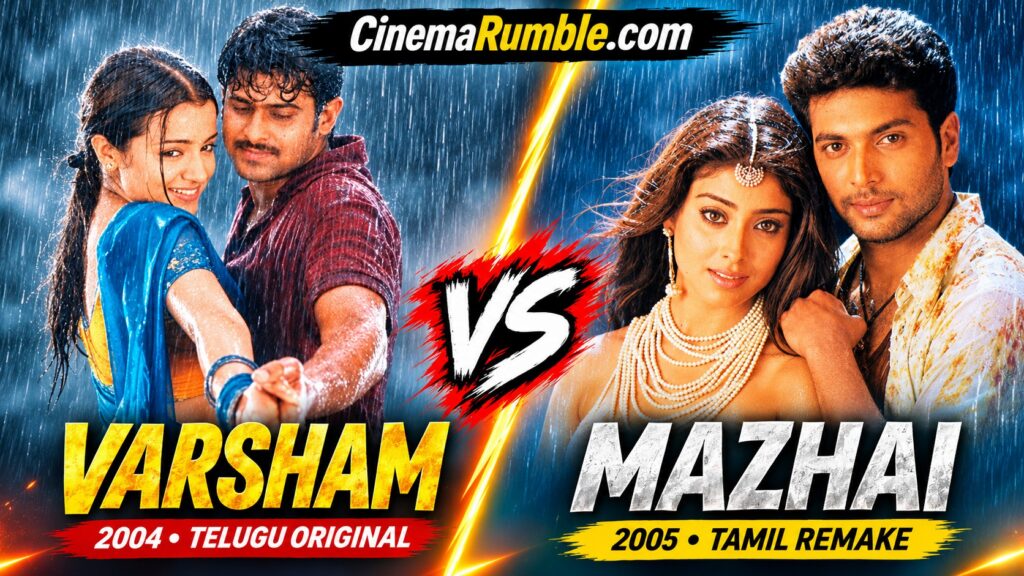
Directed by Sobhan, Varsham brought Prabhas and Trisha together as Venkat and Sailaja, with Gopichand as a threatening rival. Its rain-soaked romantic imagery, family conflict, and Devi Sri Prasad soundtrack set the film apart from an ordinary action romance. Trisha’s expressive response to the love story is especially central: Sailaja is not merely someone the hero must rescue, but the emotional center of the relationship.
Rajkumar’s Tamil remake Mazhai stars Jayam Ravi and Shriya Saran as Arjun and Shailaja, with Rahul Dev taking the antagonist’s place. The rain-centered meetings and movement towards danger are retained. Devi Sri Prasad also handled the Tamil soundtrack, making the music connection more direct than in many other remakes. Vadivelu and other Tamil supporting performers provide the local comic register.
What can feel diminished is the seamless progression from tender romance to the more forceful conflict. Contemporary criticism questioned Mazhai‘s freshness and warmth, while Varsham had already become a substantial commercial and musical success. At the Filmfare Awards South, Trisha won Best Actress for the original, and Devi Sri Prasad won Best Music Director. Their contributions help explain why this particular remake had such a high emotional benchmark.
5. Kick (2009) vs Thillalangadi (2010): One Idea, Two Comic Temperaments
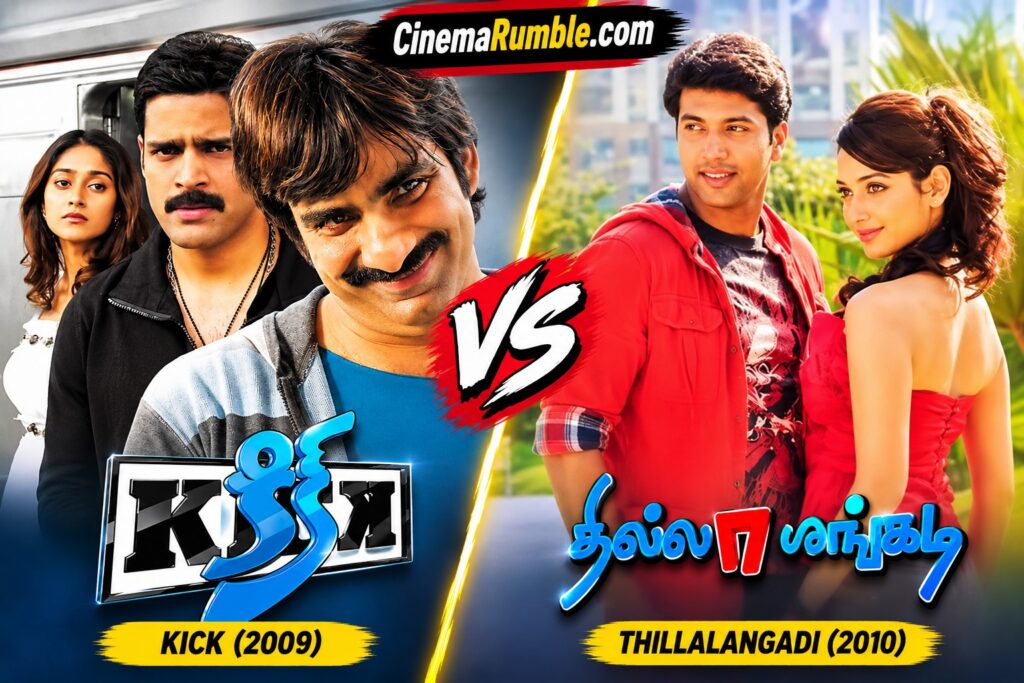
Surender Reddy’s Telugu Kick revolves around an unpredictable young man, played by Ravi Teja, who wants excitement rather than a conventional routine. Ileana D’Cruz is his romantic counterpart, and Shaam plays the investigating police officer. The central joke works because Ravi Teja makes his character’s reckless behavior both irritating and strangely persuasive. S. Thaman’s soundtrack reinforces the film’s playful energy.
For Thillalangadi, director Mohan Raja cast his brother Jayam Ravi and Tamannaah Bhatia, with Shaam reprising his police role from the Telugu original. The Tamil film draws on Yuvan Shankar Raja and S. Thaman for its music and uses recognizable comedians, including Vadivelu and Santhanam, to broaden the humor. It also runs for roughly three hours, so the same cheeky premise has to sustain a particularly long film.
Jayam Ravi takes a more straightforward, boyish approach than Ravi Teja’s mischievous, fast-talking performance. The comparison isn’t simply about which actor is funnier; it is about the pace needed to sell a protagonist who keeps disrupting the lives of those around him. Thillalangadi had a decent theatrical opening in Chennai and was later listed as an average performer in local trade tracking.
6. Athanokkade (2005) vs Aathi (2006): Vijay Enters a More Conventional Revenge Template
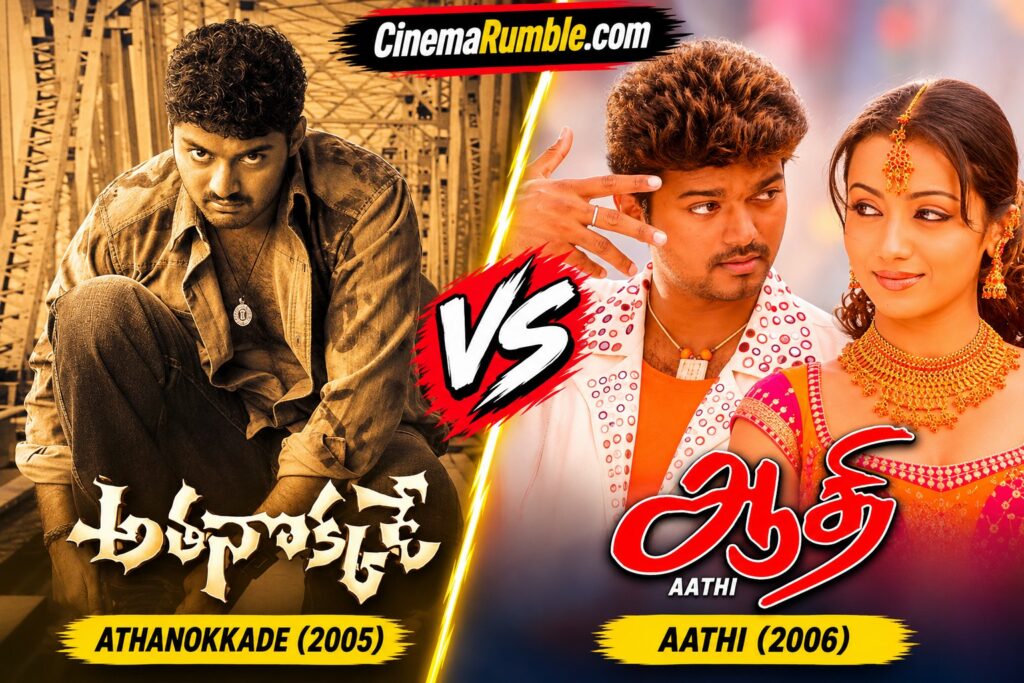
Athanokkade, directed by Surender Reddy, was a significant action success for Nandamuri Kalyan Ram (NKR), opposite Sindhu Tolani. The revenge plot gave its hero a serious emotional purpose beneath the fights. Its handling of concealed history and the slow buildup of the central grievance made the violence feel personal.
Ramana’s Tamil version Aathi brings Vijay and Trisha together, supported by actors including Prakash Raj, Sai Kumar and Nassar. The principal revenge structure is retained, but it sits inside the familiar expectations of a Vijay commercial entertainer. Star presence, confrontations and songs alter the balance between the mystery of the past and the hero’s present-day action.
Vijay and Trisha remain an appealing pairing, yet the film drew poor reviews and did not recreate the source film’s breakout status. Aathi was a box-office disaster and the start of Vijay joke meme templates. Reviews at the time of release disagreed about how effectively the adaptation handled its source material.
For a broader look at Vijay’s relationship with remakes, CinemaRumble’s Vijay remake movies guide follows that career pattern well beyond this one film.
7. Aadi (2002) vs Jai (2004): The Burden of a Breakthrough Role
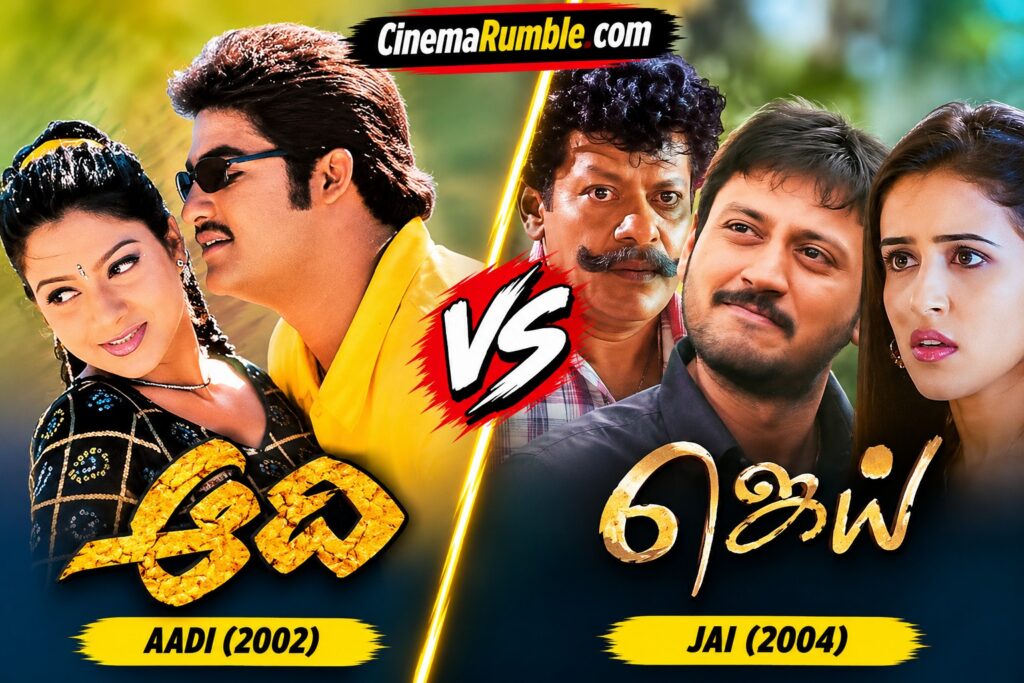
V. V. Vinayak’s Aadi was one of the early films that established Jr NTR’s command of the Telugu mass-action format. Keerthi Chawla played the female lead. NTR’s youthful intensity, emphatic dialogue delivery, and the revenge-driven family stakes made the film particularly important to his rise. Those elements are not merely decorative; the story is structured around the audience believing in the hero’s anger.
Jai, directed by S. Narayan, shifts the material to Prashanth, with Anshu as the female lead and Thiagarajan, Rajkiran and Bhanupriya among the supporting actors. The revenge narrative and hero-centric structure remain recognizable, while Prashanth brings a different personality to the central role. What worked for a young NTR at a specific moment in Telugu cinema did not automatically become a career-defining character for a Tamil star working in another market.
The Tamil film underperformed commercially. That does not make its performers unworthy of attention; it illustrates how an early-career breakthrough can depend on the original actor’s developing identity.
8. Simhadri (2003) vs Gajendra (2004): When a Blockbuster’s Emotion Meets a Different Star Image
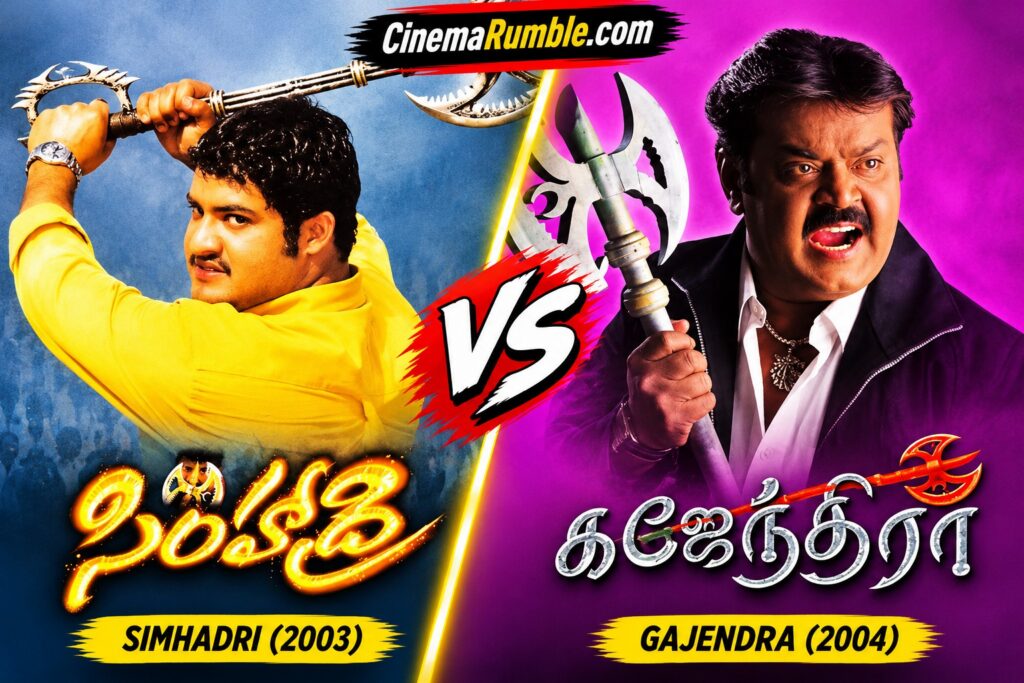
Simhadri is a major landmark in the early careers of both Jr NTR and director S. S. Rajamouli. With Bhumika Chawla and Ankitha in prominent roles, the story combines household loyalty, a vulnerable relationship, and powerful action. M. M. Keeravani’s music gives the emotional passages a distinct identity. NTR’s ability to move from gentleness to anger is crucial to the film’s dramatic design.
Suresh Krissna directed the Tamil version, Gajendra, starring Vijayakanth alongside Laya and Flora. Deva composed the Tamil music. The action framework survives, but Vijayakanth enters it as an already established star with a very different heroic reputation. A character originally meant to prove a rising actor’s range becomes another large-scale vehicle for a senior star.
Gajendra did not replicate Simhadri’s extraordinary theatrical impact. The Telugu original’s celebrated run and later re-release also mean its cultural footprint can be documented separately from uncertain old collection estimates. A useful way to revisit NTR’s performance is through the emotional exchange with Nassar, which illustrates the family stakes beneath the action.
9. Pataas (2015) vs Motta Shiva Ketta Shiva (2017): What Happens When Police Drama Gets Louder?
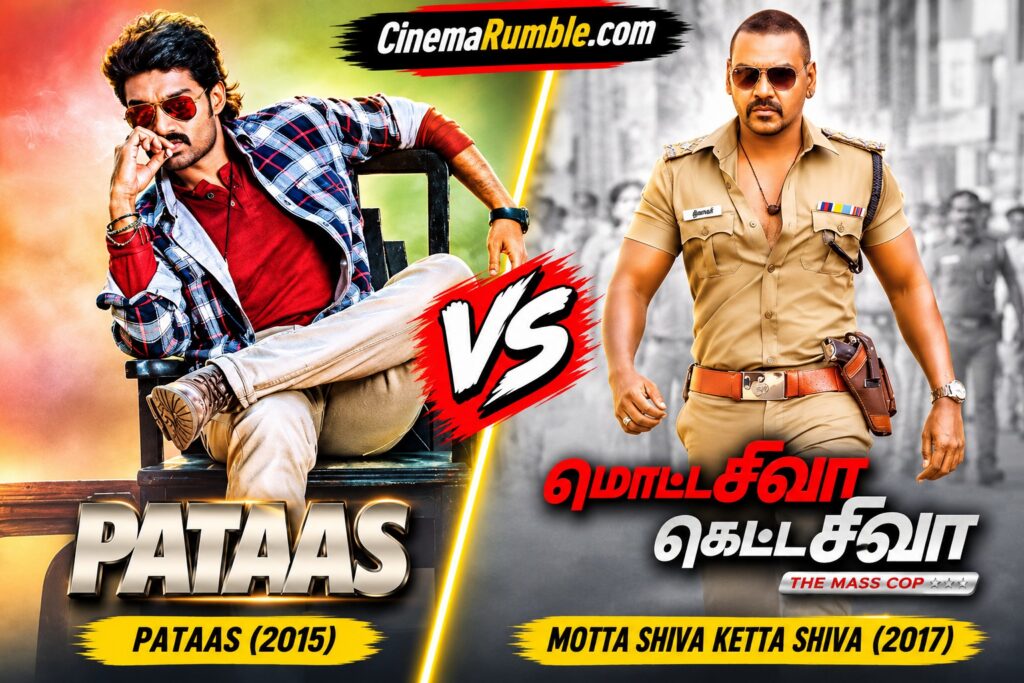
Anil Ravipudi’s directorial debut Pataas gave Nandamuri Kalyan Ram a lively police role opposite Shruti Sodhi. The hero begins as an ethically compromised officer, and his difficult relationship with his father supplies the story’s emotional core. Supporting performers, including Sai Kumar and Ashutosh Rana, make the confrontation more than a sequence of punch dialogues. Its commercial success showed that an old-fashioned police entertainer could still feel nimble when paced confidently.
In Motta Shiva Ketta Shiva, director Sai Ramani cast Raghava Lawrence, Nikki Galrani and Sathyaraj, retaining the corrupt-cop-to-reformed-officer movement. The Tamil adaptation intensifies the hero projection and relies heavily on forceful confrontations. Lawrence’s dance ability provides a recognizable attraction, but the screenplay’s treatment of sexual violence and sudden moral transformation was criticized on release.
This is among the stronger cases for a sharply negative assessment of a remake, because contemporary reviews documented serious problems with its handling of women and police power. The criticism is not that a Tamil action movie must imitate Telugu comedy exactly. It is that its added emphasis needs to support, rather than overwhelm, the character’s moral turning point.
10. Bhale Bhale Magadivoy (2015) vs Ghajinikanth (2018): Nani’s Forgetfulness Gets a Rajinikanth Makeover
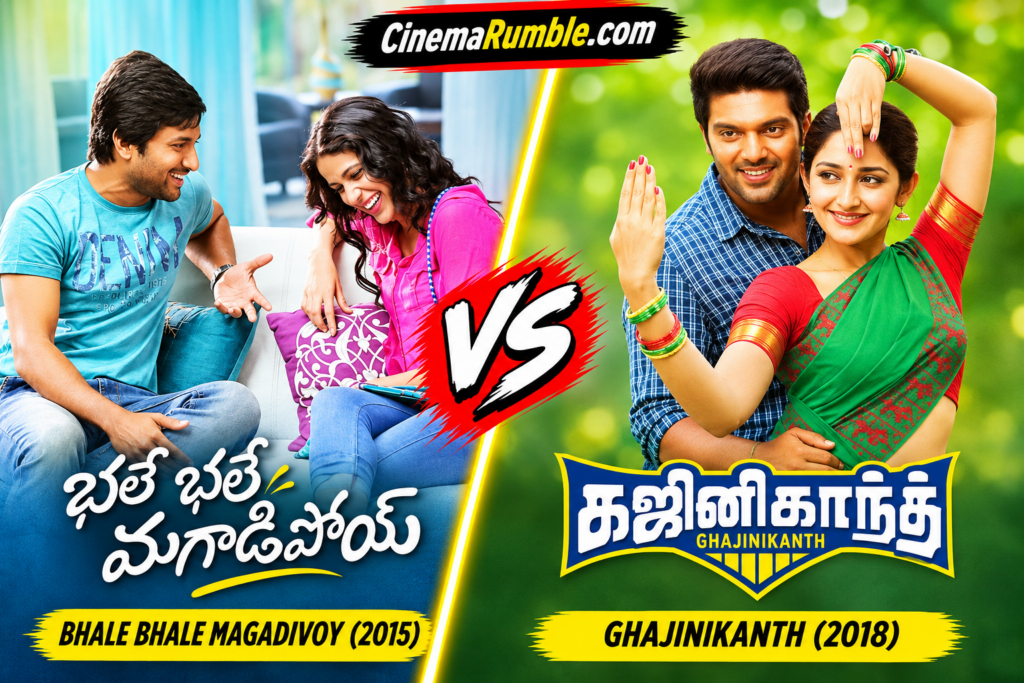
Maruthi’s Bhale Bhale Magadivoy is built around a remarkably simple comic device: its protagonist, played by Nani, repeatedly loses track of what he is doing when his attention shifts. Lavanya Tripathi is the romantic lead. The resulting misunderstandings let Nani make a flawed, distracted young man likable without presenting him as a conventional action hero.
Ghajinikanth, directed by Santhosh P. Jayakumar, casts Arya opposite Sayyeshaa. Its hero is deliberately named Rajinikanth, and the film adds Tamil star references around the absent-mindedness premise. Those jokes are a conscious form of localization, not evidence that the remake is entirely identical. Arya’s approach is more physical and broad, while supporting actors such as Sampath help several comic situations register.
Reception was divided: some critics found the film entertaining, while others felt the romantic writing and humor were inconsistent. Nani’s nuanced comic performance remained a frequent point of comparison. He won the Filmfare Critics Award for Best Actor (Telugu) for Bhale Bhale Magadivoy, a useful reminder of the acting achievement behind the apparently light premise. The source story also led to the Kannada remake Sundaranga Jaana (2016).
11. 100% Love (2011) vs 100% Kadhal (2019): The Problem of Remaking an Old Romance Without Rethinking It
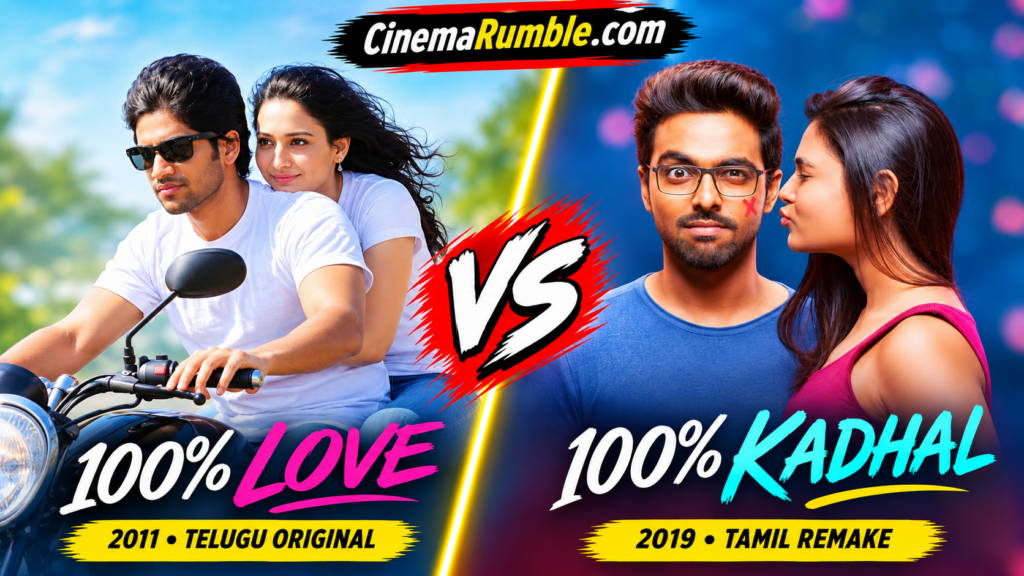
Sukumar’s Telugu 100% Love stars Naga Chaitanya and Tamannaah Bhatia as academically competitive relatives whose pride complicates their attraction. The film’s lightness depends on the two performers finding comic energy inside the rivalry. Devi Sri Prasad’s songs also contribute to the playful mood, even when the central characters are stubborn or immature.
Nearly eight years later, 100% Kadhal brought the storyline to Tamil with G. V. Prakash Kumar and Shalini Pandey, directed by M. M. Chandramouli. Names and major relationship conflicts remained recognizable. But the cultural distance between 2011 and 2019 mattered: dialogue about education, marriage and gender expectations that had once passed within a conventional romantic comedy attracted much stronger scrutiny.
Contemporary Tamil reviews were particularly severe, questioning both the character writing and the lack of meaningful updating. This pair offers a different lesson from the action-film examples. Sometimes fidelity itself becomes the problem. A remake needs to ask whether the source’s assumptions still work for its intended audience, not just whether the plot remains recognizable.
12. Ala Modalaindi (2011) vs Yennamo Yedho (2014): Rom-Com Timing Across Languages
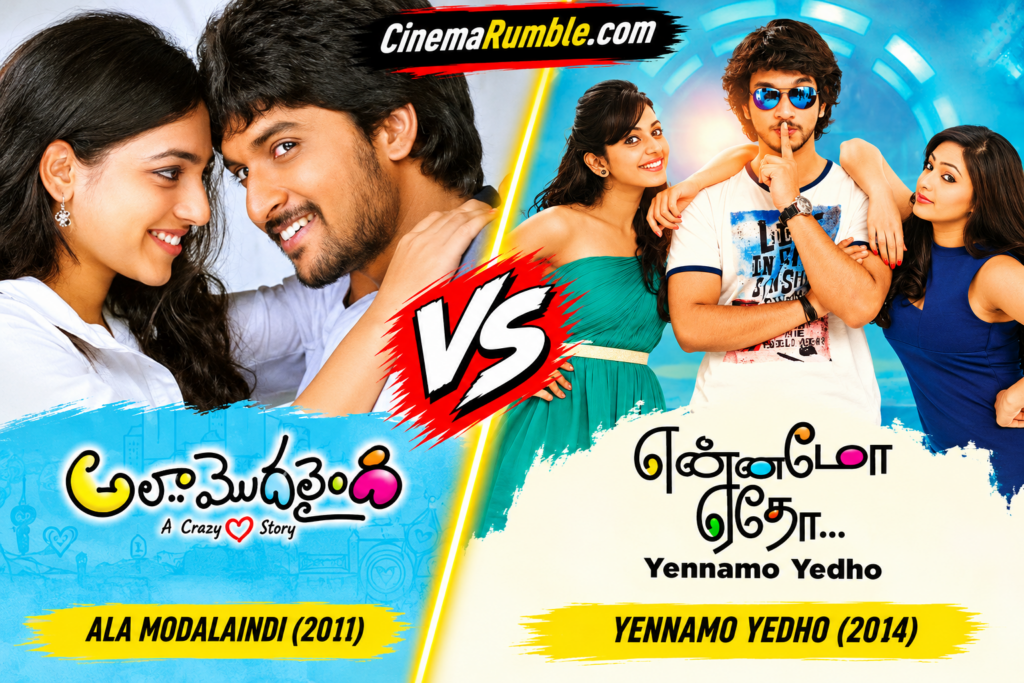
Nandini Reddy’s Ala Modalaindi was a warmly received romantic comedy led by Nani and Nithya Menen. Its appeal came from conversational banter, believable hesitation, and the way coincidences gradually brought the two characters together. Nani’s casual spontaneity and Nithya Menen’s directness are as important to the humor as the underlying twists.
Ravi Thyagarajan’s Tamil adaptation, Yennamo Yedho, stars Gautham Karthik, Rakul Preet Singh and Nikesha Patel. It retains the romance-of-chance framework but recalibrates its songs, supporting cast and comic accents. D. Imman’s music supplies a separate Tamil identity, while the story’s multiple misunderstandings depend heavily on the lead actors making contrived situations feel effortless.
This is not a case where a universally accepted commercial verdict can be substituted for film analysis. The more revealing contrast is tonal. The Telugu version’s rapport between its leads made the writing feel lighter; the Tamil version was repeatedly compared with that ease. When an original romantic comedy is driven by conversational chemistry, localization involves much more than replacing a few jokes.
⚖️ Cast and Character Functions: The Comparisons That Matter Most
| Original function | Telugu performance | Tamil counterpart | Why the match matters |
|---|---|---|---|
| Quick-thinking crime-comedy hero | Allu Arjun in Julayi | Prashanth in Saagasam | Dialogue pace and playfulness |
| Rain-linked romantic protagonists | Prabhas and Trisha in Varsham | Jayam Ravi and Shriya Saran in Mazhai | Warmth and rising dramatic tension |
| Thrill-seeking romantic hero | Ravi Teja in Kick | Jayam Ravi in Thillalangadi | Comic temperament and narrative pace |
| Revenge-centered young action lead | Jr NTR in Aadi | Prashanth in Jai | Intensity tied to career stage |
| Emotional mass-action protagonist | Jr NTR in Simhadri | Vijayakanth in Gajendra | Contrasting star identities |
| Distracted romantic-comedy hero | Nani in Bhale Bhale Magadivoy | Arya in Ghajinikanth | Natural reactions versus broad physical comedy |
| Corrupt officer who must change | Kalyan Ram in Pataas | Raghava Lawrence in Motta Shiva Ketta Shiva | Character growth versus hero elevation |
🏆 Performances, Hit Films and Awards Behind the Comparisons
Several originals on this list were more than routine successful releases. Aadi and Simhadri helped consolidate Jr NTR’s early commercial identity, while Varsham strengthened Prabhas’s romantic-action image and gave Trisha an award-winning part. Happy Days was a launchpad for much of its ensemble and won Filmfare recognition for its film, direction, and music. The 2007 Nandi Awards also recognized it as the second-best feature film.
The acting achievements are specific, not interchangeable. Allu Arjun’s strength in Julayi is the precision with which he moves between confidence and quick humor; Ravi Teja’s Kick works through mischief; Nani’s Bhale Bhale Magadivoy turns small lapses of attention into sustained situational comedy; and Jr NTR’s Simhadri relies on the distance between compassion and volcanic anger. Trisha’s Varsham performance won the Filmfare Award for Best Actress (Telugu), and Nani won the Filmfare Critics Award for Best Actor (Telugu) for Bhale Bhale Magadivoy.
Not every Tamil adaptation deserves the same box-office label. Jai and Gajendra are documented underperformers; Thillalangadi had a respectable opening but less impressive subsequent trade tracking; Inidhu Inidhu, Mirattal and Ghajinikanth attracted genuine positive as well as negative reviews.
🌳 Remake Chains: These Stories Did Not Stop at Tamil
Some successful Telugu premises attracted several independent adaptations, which should be shown as branches rather than one misleading film-to-film chain:
- Happy Days (Telugu, 2007) → Jolly Days (Kannada, 2008) and Inidhu Inidhu (Tamil, 2010).
- Simhadri (Telugu, 2003) → Gajendra (Tamil, 2004) and Kanteerava (Kannada, 2011).
- Bhale Bhale Magadivoy (Telugu, 2015) → Sundaranga Jaana (Kannada, 2016) and Ghajinikanth (Tamil, 2018).
- Kick (Telugu, 2009) → Thillalangadi (Tamil, 2010) and Kick (Hindi, 2014), separate adaptations of the Telugu premise.
🎵 Why Songs, Comic Timing and Star Image Can Make or Break a Remake
Music is more than an optional addition to these comparisons. The melodies associated with Varsham and Happy Days helped viewers remember relationships and moments beyond the basic plot. Both Mazhai and Inidhu Inidhu retained a connection with the source film’s composer, yet the emotional context shifted with the changed cast and performances. Julayi and Kick demonstrate a different challenge: the audience hears a new soundtrack while remembering the precise timing of the original hero’s comedy.
When adapting material already famous for a particular performance, producers are effectively remaking two things: the screenplay and the persona attached to it. The second cannot simply be copied. Successful remakes such as Ghilli prove that Tamil cinema can fully possess a Telugu source story through its own stars, music and staging. The twelve films above are useful precisely because their results and reputations were less straightforward.
CinemaRumble’s Pawan Kalyan remake-film retrospective provides another perspective on how an actor’s screen identity changes inherited material.
✅ Final Perspective: What These Twelve Remakes Actually Teach Us
No single formula explains a disappointing remake. Saagasam shows the limits of close replication, Mirattal highlights the importance of a comedy ensemble, Gajendra shows how a story changes with the hero’s screen image, and 100% Kadhal demonstrates the risks of transferring dated romantic assumptions without meaningful revision. In other cases, like Inidhu Inidhu and Ghajinikanth, Tamil films have genuine admirers even if comparisons favor their Telugu inspiration.
What made Julayi, Happy Days, Kick, Simhadri and the other originals matter was never only a successful plot. It was the meeting of story, actor, supporting cast, music, timing, and the expectations of a particular audience. A remake succeeds when it finds that combination again on its own terms. That is a more interesting test than simply asking whether an original should ever have been remade.